
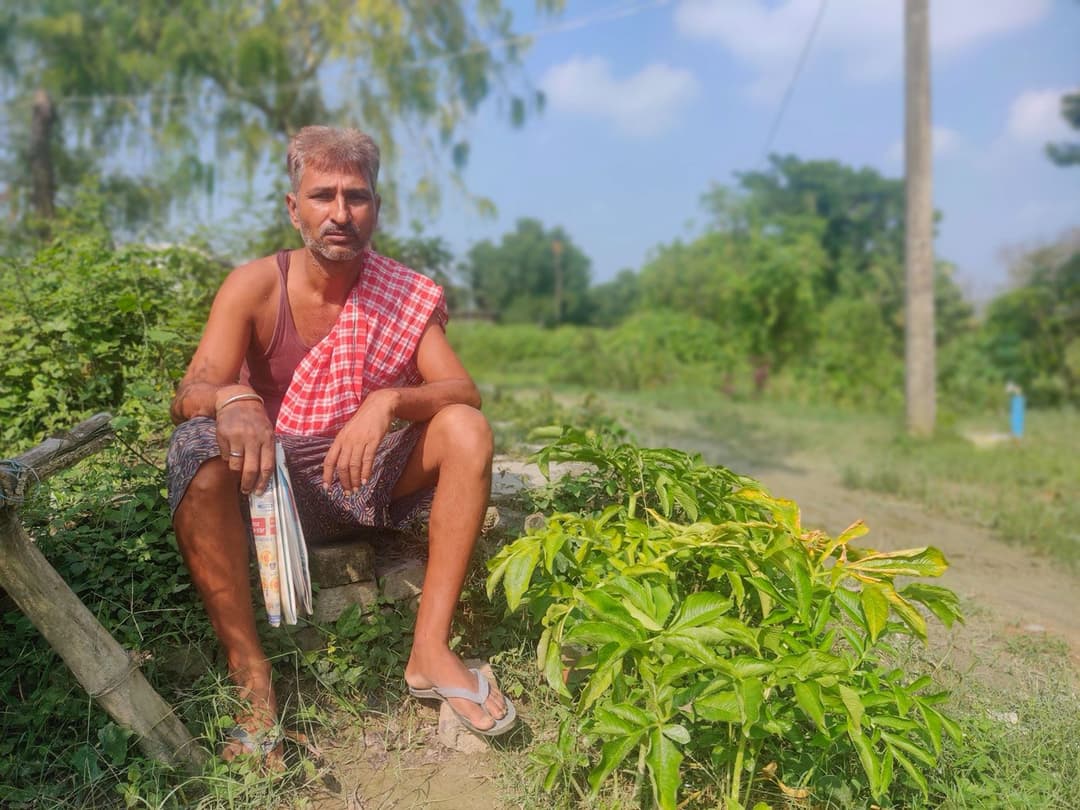
Rajiv Kumar Ojha does not know which is more stressful: harvesting a decent crop or trying to sell it. “You might find it funny, but my troubles begin after I get a good harvest at the end of the cropping season,” he said, sitting in the verandah of his dilapidated house in Chaumukh, a village in north-central Bihar.
Ojha, 47, cultivates paddy in the kharif season (June-November), and wheat and maize during rabi (December-March) on his five-acre farmland in the village, located in Muzaffarpur district’s Bochaha taluka. “Weather, water, labour and many more things need to come together for us to get a good harvest,” he told me in November 2020. “But even after that, there is no market. I have to sell my stock to the commission agent in the village, and I have to sell it at the price he fixes.” The agent in turn sells it to a wholesale trader for a commission.
In 2019, Ojha sold his stock of raw paddy at the rate of Rs. 1,100 per quintal – this was 39 per cent less than the MSP (minimum support price) of Rs. 1,815 at that time. “I didn’t have an option. The agents always buy at a lower rate because they know we can’t go anywhere [to sell]. So we hardly make any profit,” he said.
A farmer in Bihar invests Rs. 20,000 on an acre of paddy, said Ojha. “I get 20-25 quintals of harvest on an acre. At 1,100 rupees a quintal, I can make a profit of 2,000-7,000 rupees [per acre] after six months of hard work. Do you think it’s a fair deal?”
Like Ojha, many farmers in Bihar have been struggling to get better prices for their crops, especially after the state repealed the Bihar Agriculture Produce Market Act, 1960, in 2006. With that, the agricultural produce market committee (APMC) mandi system was abolished in the state.


