But Kamtha could not sustain its protest beyond a week. “We stretched it as much as we could," says Vikas. "In just a week, the three of us lost 80,000 rupees [because we stopped sending stock to the market].” Vikas, 43, is referring to himself and his two brothers; together they own 20 acres on which they grow vegetables and produce milk. “It will take us a year to recover the loss we incurred during the strike,” he adds. The Patade brothers have a debt of Rs. 8 lakhs, and a loss like this greatly adds to their burden.
So after a week of a brave fight – the strike shut down the markets of Osmanabad and Kalamb for seven days – Kamtha had to give in. "We are responsible for our families," Vikas says. The village mostly cultivates vegetable, and sends stocks worth an estimated Rs. 70,000 to the markets every day. “For a week, they had no stock,” he says. “I know a village of 1,700 people [around 1860 according to Census 2011] cannot shake the might of the state. But we wanted to be a part, even if a small one, of this movement.”
Ahmednagar and Nashik districts remained the centres of the recent strike, while sporadic morcha s and strikes erupted – only to calm down– in the traditionally distress-prone agrarian zones of Marathwada (as well as Vidarbha).
Why was the agitation in Marathwada not as intense and sustained? Except for villages like Kamtha in pockets of Osmanabad, the response by farmers to the strike across the five other districts in Marathwada – Beed, Aurangabad, Jalna, Latur and Nanded – was lukewarm. Only Parbhani and Hingoli districts in Marathwada saw more sustained protests.
Possibly the most important reason is that the region simply cannot afford a strike. Farmers in Nashik and western Maharashtra are relatively better off, while Marathwada’s farmers have been through four years of drought from 2012 to 2015; the acute water shortage has left them even more on the precipice.
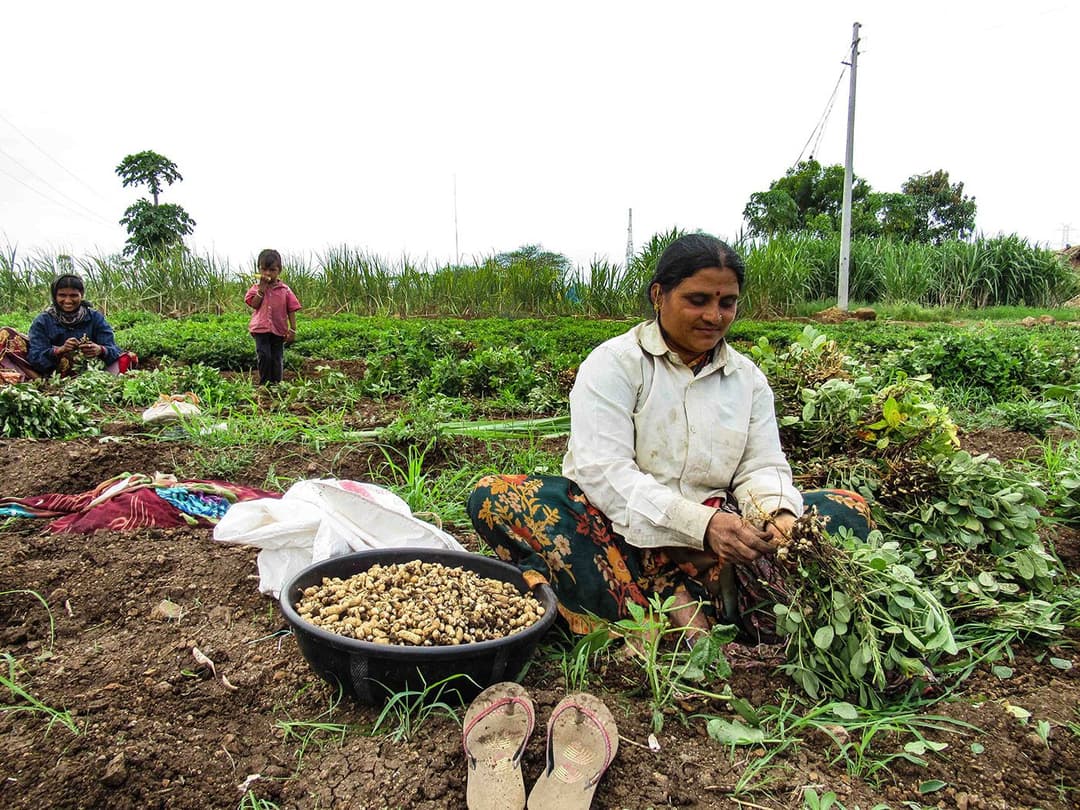
In Beed’s Limbaganesh village, Mahananda Jadhav, 45, was busy picking groundnuts on her four-acre farm when I met her one afternoon. She is on thin ground, and a strike would further wreck her. “Our galanda flower last year completely dried up,” she says. “That cost us 50,000 rupees. Plus, we introduced drip irrigation on our farm and drilled a borewell. We already owe 2 lakh rupees to the bank.”
The galanda crop’s failure came on top of another problem: “We sowed tur last year but could not sell it due to the chaos at the government centres,” Jadhav says. “If we had sold it, we could have bought pesticides, seeds and fertilisers for the upcoming cropping season without credit.”
Two of Jadhav’s sons, aged 22 and 25, are in Beed studying for a BSc degree. Participating in the strike would have impacted Jadhav’s chances of paying their fees as well. “We have to pay almost one lakh rupees [annually] for each of them,” she says.