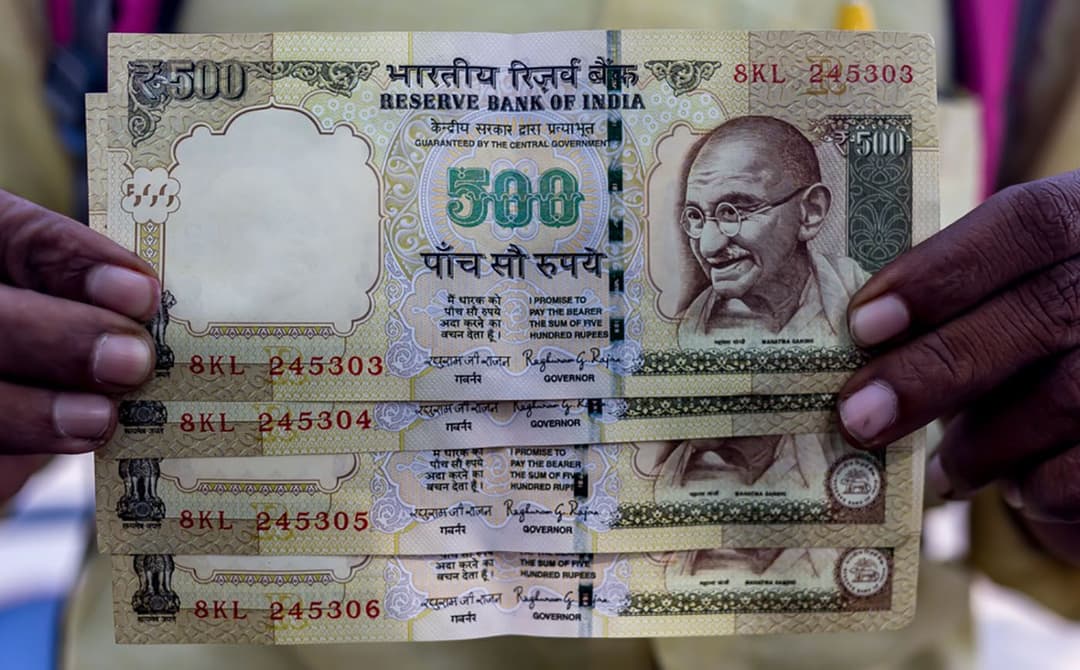
He was stumped. He soon noticed that the notes had sequential numbering – as if they were fresh from a bank. So he reasoned that unused money had emerged from a hidden stack. He suspects that large amounts of black money are being used by Anatapur’s traders and those from nearby districts or from Tamil Nadu to buy crops from the farmers in the 11 villages of Tadimarri mandal , where the population of 32, 385 is entirely rural and literacy levels are low.
Except for a few like Umesh, demonetisation has adversely affected everyone in Tadimarri village. And because Umesh accepts the old currency (which he deposits in his bank account as a legitimate part of his income), farmers here are quickly repaying their long due fertiliser payments.
Meanwhile, not far from the fertiliser outlet, the liquor stores in Tadimarri village are doing brisk business too – because these shops, authorised as well as unauthorised, are also accepting the old notes.
“This is the 50 rupees we got back,” a slightly inebriated China Ganganna shows us. He has just used up a 1000 rupee note to buy alcohol – to be shared among eight other jobless agricultural labourers. To change a Rs. 500 note, at least Rs. 400 worth of alcohol must be purchased.
Many in Tadimarri are finding that the easiest way to change their old currency notes is by buying alcohol. “I used to drink a quarter bottle every day [after work],” says S. Nagabhushanam, who drivers tractors on farmers’ fields. A quarter of country liquor here costs between Rs. 60-80. Nagabhushanam now drinks about 4-5 times more than his usual quota. His daily wage is Rs. 500 – but he is presently jobless, so all he has of his earnings are the old notes. He spends these at the liquor shop.
Like Nagabhushanam, agricultural labourers in Tadimarri are having a hard time finding work. The groundnut crop has been dismal this year due to a deficient monsoon in Anantapur. Many farmers have lost their crops, and paid work days for agricultural labourers have decreased.
Farmers in Tadimarri mandal harvest their groundnut crop after Diwali, around November, and continue to sell it through December. The farmers don’t pay the agricultural labourers working on their fields every day or every week. The labourers’ accumulated wages are paid only after the season’s harvest. So the farmers require large sums during this time of the year.
The farmers also use this money to repay their informal loans among themselves, which are taken at a 2 per cent per month interest rate. “If we don’t pay this money now, the interest will keep increasing,” says T. Brahmananda Reddy, a farmer who owns around 16 acres of land in Tadimarri village.
Reddy sold his groundnut crop a week after demonetisation, and was paid in old notes of Rs. 500 and Rs. 1000 by traders from other districts. He has deposited the money in his account, but needs a bulk amount of the new notes to pay his debts and his labourers – and these notes are still scarce at the three banks in Tadimarri mandal .