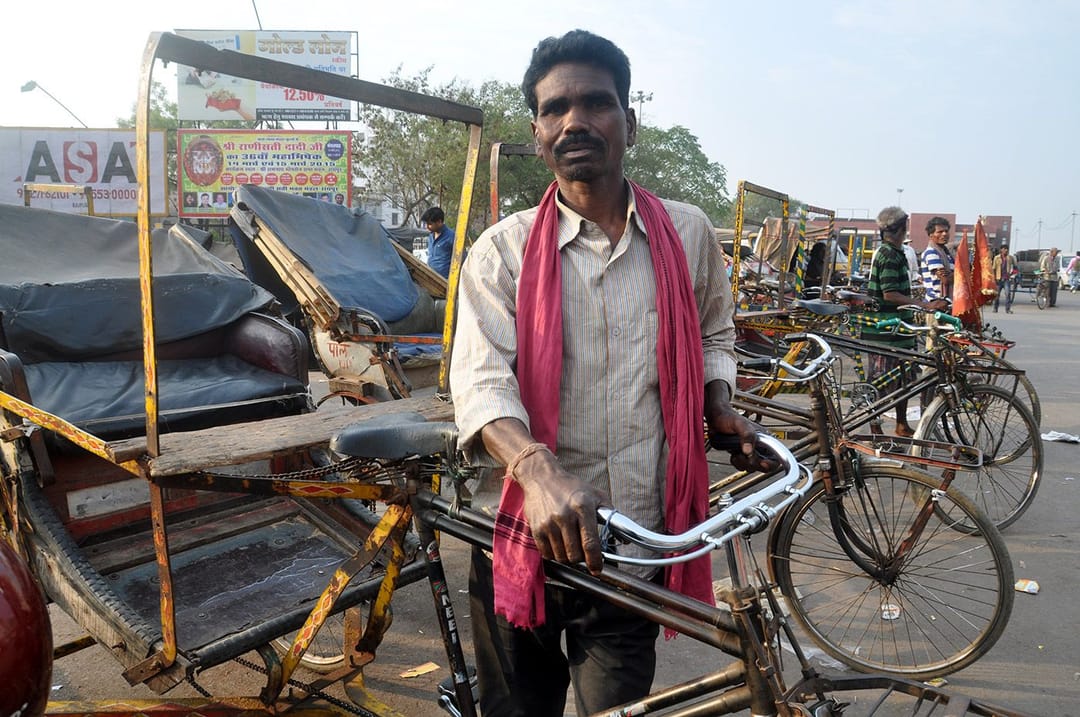
Prasanna was married when he was just 16. He has two sons – Jitu, the elder son, got married at 23 and has a son of his own. The family spent Rs. 15,000 on the baby’s 21st day ceremony – he was their first grandson. Do you want him to study, we ask. “Of course," he says, holding his arms up to the sky, “If god lets me live, I will make sure he studies well.”
Prasanna himself studied only till Class 5. Then his parents put him to work on their small piece of land. In 1965, the year Prasanna was born, there was a severe drought in Kalahandi, which was followed by drought every alternate year. When he was just a few weeks old, Prasanna’s parents took him along to see then prime minister Indira Gandhi, who visited Khariar to review the situation. Thousands of people, he says, died of hunger and disease in that drought.
Prasanna's sons don't have much of an education either. Jitu could not clear his Class 10 exam, and the younger one, Rabi, only studied up to Class 7. Both are migrant labourers at construction sites in Mumbai. Boys from the village go in groups to the cities to work. They live at the construction sites and are paid a daily wage of roughly Rs. 300. Many earn more doing overtime work. They return home with a substantial amount after 3-6 months, spend some time with the family or work in the field, and again migrate. So it goes on.
“After the harvest, half the village used to go to Andhra Pradesh to work in the brick kilns. The labour contractors pay Rs. 20,000 and take the whole family to work for them. I never opted for this because I can earn Rs. 30,000 for my family if I spend three months in Mumbai as a construction labourer,” Prasanna says. "Why would I want my entire family to lead such a difficult life?"
Kiln contractors pay Rs. 20,000-30,000 per pathria in advance. A pathria is a unit of three people working at the same brick kiln. The local sardars or agents hand the migrants over to labour contractors, who turn them over to the kiln owners. They spend around six months at the kilns and return to their villages before the monsoon, in the months of May and June.
The journey, the poor living conditions and the hard work often result in ill health. Many of the workers get tuberculosis. But the money paid in advance lures them. There is no other way to meet major financial exigencies such as the cost of a marriage in the family, health care, constructing a house, purchasing bullocks or repaying loans.
The Mahatma Gandhi National Rural Employment Guarantee Act has not effectively stemmed migration. Payment is irregular and there is no assurance of regular work. Only those who can afford to wait for wages stay back in the village to work in the fields or on MGNREGA worksites.
Prasanna’s family spent around Rs. 100,000 on his younger son Rabi’s marriage last year. The father and sons pooled their earnings and also took a loan from relatives. They served a non-vegetarian feast, and engaged a videographer to film the entire event. "We have two DVDs of the marriage," says Prasanna proudly.
Do you have a BPL (below poverty line) card? “Yes, I have a BPL card and my father has one too," Prasanna replies. The family gets 25 kilos of rice at Re. 1 per kilo on each card under the public distribution system (PDS). That's 50 kilos of rice for Rs. 50 and four litres of kerosene for Rs. 70 every month.
The subsidised rice is a huge help for families like Prasanna's – it keeps starvation at bay. Earlier, people took on any kind of work for small quantities of foodgrain. The PDS has enabled them to bargain for slightly better terms, and wage rates have been revised as a result. The subsidy allows families to think beyond food, to health care and education.
Prasanna's father also gets a pension – Rs. 300 a month for those over 60 and Rs. 500 for those over 80. The PDS and the old age or widow’s pensions turn the elderly into contributing members of the family, giving them a new dignity.
Though the welfare measures have provided a measure of security to many communities here, they have not stemmed migration from these villages. So Prasanna and others still go to the cities looking for work.