
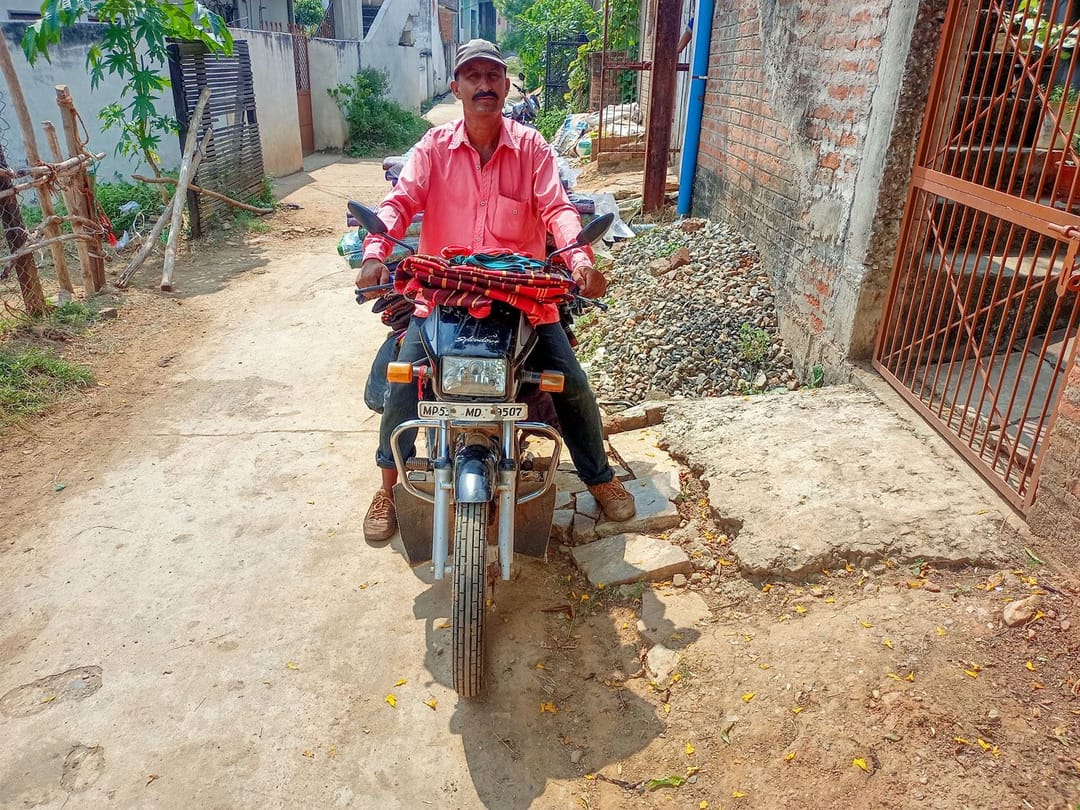
It’s time for his first sales pitch of the day. Bachu stops his motorcycle near a group of 9-10 women gathered at a handpump in Shivpurwa village. “Didi, please look at the design,” he says. “You will not get such sarees even in the big shops in Sidhi market. There is no compulsion to buy if you don’t like.”
Then, to try and ensure his first sale of the day, a hopeful Bachu offers a hefty discount: “The price of each saree is 700 rupees but I will give it to you for only 400…”
The women examine each of the 15-20 nylon sarees in the gathar (stack). One of them says she will give 150 rupees. A miffed Bachu starts gathering his collection, tying the stack with a rope, muttering that even the purchase price of the saree is 250 rupees. The woman who might have been his first customer of the day turns back to the handpump.
Disappointed, Bachu gets onto his motorcycle to move on to Madwa, the next village on his route that day. “Sometimes people waste so much time but don’t buy anything,” he grumbles, speaking in the local Bagheli language. “A lot of our time is wasted in just folding and unfolding the sarees and making the gathar.”
He stops at the handpump in Madwa, roughly three kilometres later, to drink water. “Four hours have passed since I started my journey,” he says. “But I haven’t even done my bohni [first sale of the day, considered auspicious]. This morning I spent 150 rupees on petrol and have not earned even that.”


