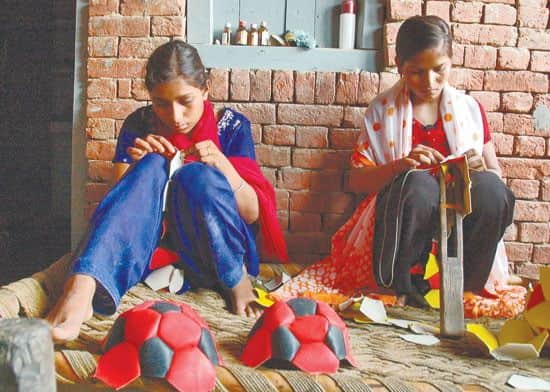

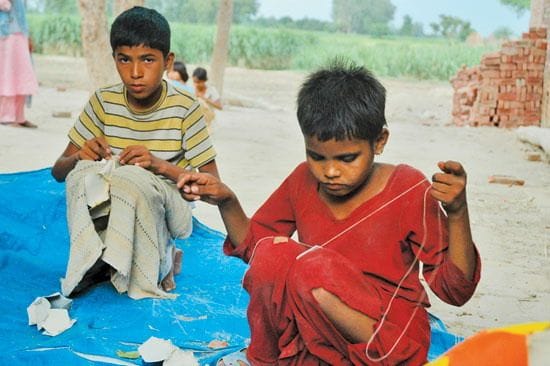
The cost of the beer three friends can knock back watching a World Cup match at a South Delhi pub is what Ishwari’s family of 17 makes in a month — just around Rs. 1,000 — stitching footballs in Kherkhi village near Meerut. Waking up early to deal with the household chores, the women and older children of the family settle down, after the men go out to work, to an arduous seven-hour routine. Ishwari, who is in her 60s, says the men don’t mind the women in the family doing this work since it doesn’t involve their leaving the house except to bring raw materials and deliver the finished goods. The family’s one financial buffer is its small plot of agricultural land — most others in the football-stitching trade in the 50-odd villages around Meerut have no such additional sources of income.
Ishwari’s family are Dalits — most ‘football-stitchers’ in the 50-odd villages around Meerut are either Muslims or landless Dalit labourers. In an average seven-hour work day, an adult can turn out three footballs; a child can make a maximum of two. For these, they are paid a measly Rs. 3 if it’s a small to average sized football, Rs. 5 for larger ones. A family of six, making around eight footballs a day, can expect not much more than Rs. 600 to Rs. 900 a month, the amount varying according to demand. Footballs, even in the local retail market, are priced anywhere between Rs. 100 and Rs. 300. If a stitch comes undone, the contractors deduct the repair cost from the labourers’ wages. In case of severe damage, such as a punctured bladder, the entire cost is recovered from the makers.
India is said to be second only to Pakistan as a producer of footballs; Sialkot in Pakistan, and Jalandhar and Meerut in India are the sport’s main manufacturing centres. For this year’s World Cup, Sialkot has exported nearly 55 million footballs to Germany; Jalandhar had the ‘star contract’ in 2002. As the World Cup pushes the football demand graph steeply upwards, some contractors call for as many as 25,000 units a day. In this rare, bumper event, the wage per unit is hiked by a mere 50 paise. With no union, bargaining power or alternate means of sustenance, the villagers acquiesce. If they refuse to work at the going rate, someone else will readily agree to do so for less — this way, at least, they’re earning 'something'.
On any given day in the tiny homes and narrow gullies of Sisola, considered the football-makers ‘headquarters’, all that can be seen of the village’s women and children are several scrawny backs hunched over the wooden apparatus of their trade, its dual needles darting in and out of the colourful pentagonal pieces of rubberised material it holds. However nimble one’s fingers, punctures from the sharp needles are frequent, as are cuts from the silk threads used to suture the material. Then there’s the inevitable damage to eyesight, brought on by the long hours of squinting. “They’ve never been trained by anyone to sit properly,” says local activist Sher Mohammad Khan, “and they end up with back problems.” With no local healthcare systems, the villagers prefer to rely on rough-and-ready home methods. Even if there are the rare doctors, they are unable to afford the costs.