
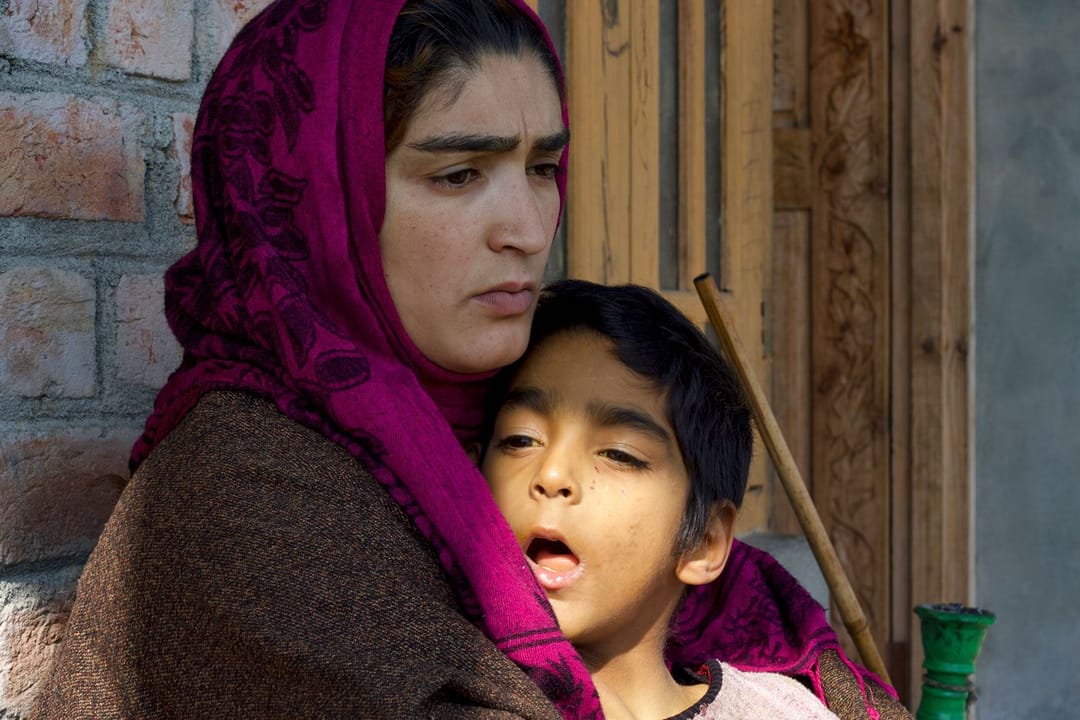
The unfinished muddy lanes stretch on for kilometres. Across these, the journey to the hospital in Soura is a recurring battle. Mubina and Arshid Hussain Akhoon have to visit the hospital at least once a month for their son Mohsin’s medical consultations. Arshid carries the nearly nine-year-old boy in his arms, across lanes overflowing at times with sewage and melting snow in the Rakh-e-Arth resettlement colony.
They are usually able to locate an autorickshaw after walking for 2-3 kilometres. It ferries them, for Rs. 500, to the Sher-i-Kashmir Institute of Medical Sciences in the Soura locality of north Srinagar, around 10 kilometres away. At times, the family has had to walk the entire distance – they did this especially during last year’s lockdown – to reach the hospital. “That takes an entire day,” Mubina says.
It’s been around nine years since Mubina and Arshid’s world changed. Mohsin was barely a few days old in 2012 when he got fever and jaundice, with extremely high levels of bilirubin. A series of visits to doctors followed. He spent two months at the state-run G.B. Pant Hospital for children in Srinagar. Finally, they were told their baby is ’abnormal’.
“When his condition didn’t improve, we took him to a private doctor who told us that his brain is completely damaged and he will never be able to sit or walk,” recalls Mubina, who is in her 30s.
Eventually, Mohsin was diagnosed with cerebral palsy. Since this diagnosis, Mubina has spent most of her time tending to her son and his health care. “I have to clean his urine, wash his bed, wash his clothes and make him sit. He is in my lap all day,” she says.


