

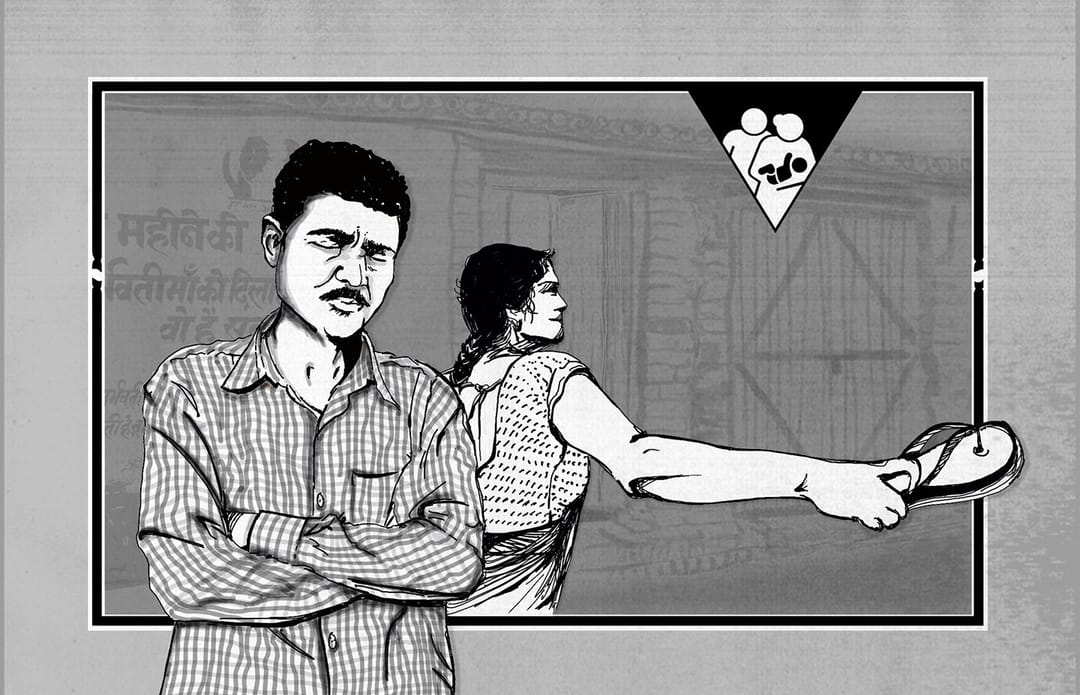
Nusrat Banno has convinced women not to have children in their teens; she has fought with their in-laws to allow them to start using contraception; and she has taken women to hospital to deliver their babies. But the 35-year-old accredited social health activist (ASHA) in Rampur village of Bihar’s Araria district believes the hardest part of her job is convincing men to get a vasectomy.
“Last year [2018], only one man agreed,” she told us in this village of roughly 3,400 people in Forbesganj block. “And after he got it done,” said this mother of four, laughing, “his wife came to hit me with a slipper.”
Rampur’s reluctance is reflected in other villages in Bihar. “Their biggest fear is that they will be ridiculed and laughed at by other men,” Vinay Kumar told me last year, just as he was about to begin another round of campaigning for an upcoming vasectomy week organised across the state every November by the government of Bihar. “They also think they will become weak, and won’t be able to have sex anymore, which is a myth.”
Kumar, 38, has spent the last year as a government-employed Vikas Mitra in Birra, a village of around 3,400 in Jehanabad’s Makhdumpur block. His tasks include creating awareness about, and implementing, various state-run schemes. Among his tasks is also the unenviable job of persuading men to agree to be sterilised – undergo a vasectomy, a minor surgical procedure during which the male vas deferens (tiny sperm-carrying tubes) are tied or sealed.
In Bihar, male sterilisations dropped from an already negligible 0.6 per cent to 0 per cent, from NFHS-3 (2005-06) to NFHS-4 (2015-16). Female sterilisation in Bihar also registered a decline in the same period – from 23.8 per cent of currently married women aged 15 to 49 to 20.7 per cent – but it remains much higher than vasectomies
The Bihar numbers reflect nation-wide data trends: across India, NFHS-4 records 36 per cent of currently married women (in the 15-49 age-group) as having undergone sterilisation, while only 0.3 per cent of these women report male sterilisation.
Condom use is also abysmally low in the country – only 5.6 per cent of currently married women aged 15 to 49 report condoms as a contraceptive measure.


