

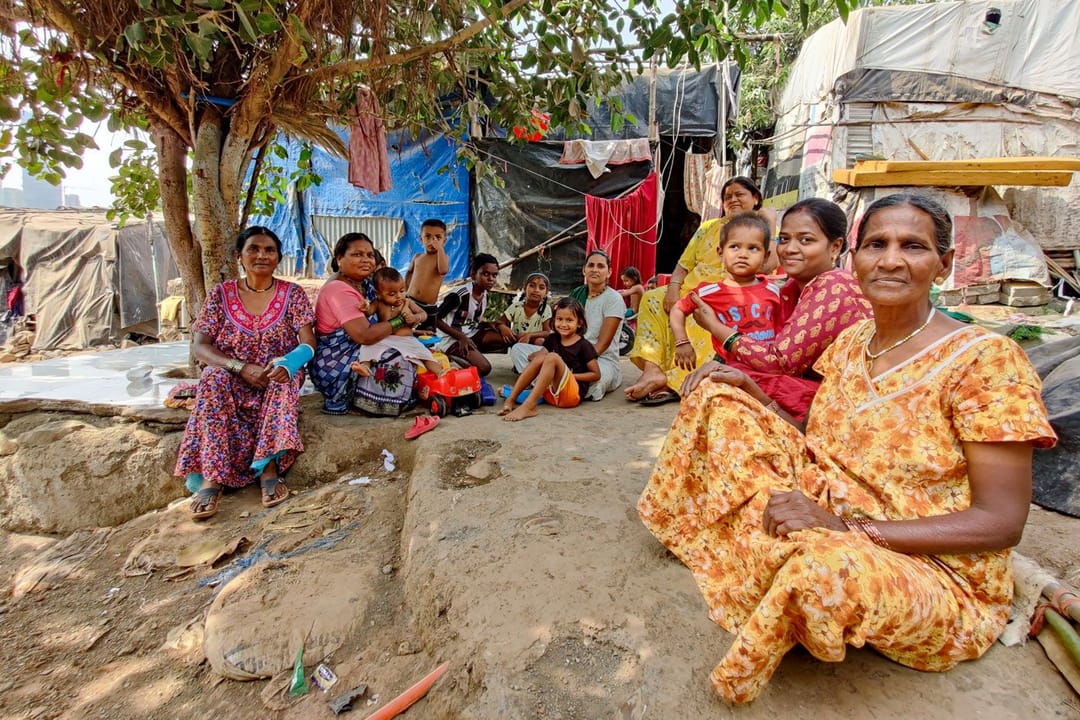
While every corner of Mumbai gets linked to the Metro and the expressways, residents of Damu Nagar struggle with a much shorter commute – but a far more difficult connection. That is: accessing the field where they still have to defecate in the open. They have to, as residents point out, step over a one-foot wall, then walk through a pile of garbage with a strong smell of faecal matter in the air. It’s an open field with dry grass, and maybe the few trees here provide a little shade for some privacy?
Not really. “There’s no such thing as privacy here,” says Mira Yede, 51, a long-time resident of Damu Nagar. “If we women hear any footsteps, we have to stand up.” Over the years, the field has been notionally divided into left and right sections for women and men to use, respectively. But, says Mira, “it’s too short a distance: A few metres away, maybe. Who has measured it anyway?” There is no physical barrier or wall between the two sections.
For the residents of Damu Nagar, many of them first or second generation rural migrants, this is an issue that outlasts elections in this part of the Mumbai North constituency. One that bothers them even as India is seeing phased voting to elect 543 members of parliament to its 18th Lok Sabha. And yet, says Mira’s son Prakash Yede, “today a narrative is created that everything is good in the country.” Prakash is talking to us on the threshold of his residence which has a metal sheet for a roof that probably raises the heat within by a few degrees.
“Nobody wants to speak about real problems in these parts of the country,” says 30-year-old Prakash. He draws attention to how Damu Nagar’s 11,000 plus residents cope with discomfort and risks arising from no access to toilets, water, electricity. Damu Nagar, a slum also known and recorded as Bhim Nagar in the Census, holds over 2,300 homes of rickety walls, tarpaulins and roofing sheets. These are perched on a hillock within the Sanjay Gandhi National Park. You have to climb up to the houses through narrow, uneven, rocky paths, trying not to step into the flowing drainage water.


