
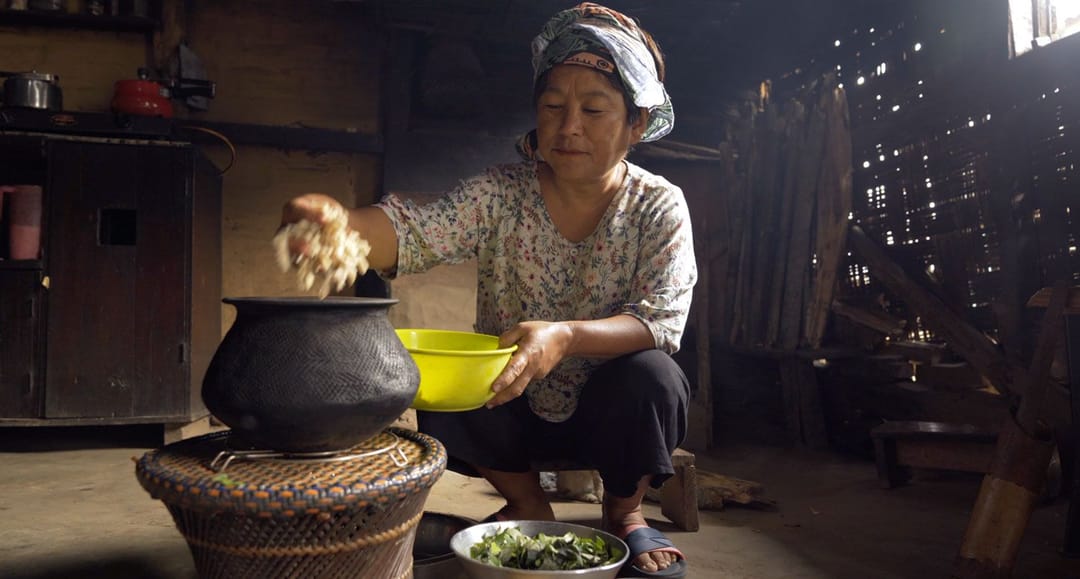
The kitchen fire has started. Tiamongla has no time to waste. She bustles about, grabbing mipang (yam) leaves she harvested from her garden this morning, garlicky chives, leaves of the thoto plant she foraged today, crab paste and more.
The 55-year-old farmer from Changki is going to prepare mipangming – an Ao Naga speciality she cooks for guests or on special occasions. “It's altogether a different dish from the rosüp, a more popular mixed vegetable dish commonly cooked amongst our tribe,” Tiamongla Longchari explains, speaking in the Changki language. She will serve the mipanming with local rice from her paddy fields and a side of local chicken fry.
The other ingredients that give mipangming its distinct flavours are salt, green chillies, tomatoes, michigan (sichuan pepper) leaves, tejang lehsün (local garlic chives), ginger leaves and jangpangnatsü (fermented crab paste). She also uses fresh vegetables in season.
Changki village has 2,486 people (Census 2011), a majority belong to the Ao Naga community (listed as Scheduled Tribe). Changki is a vulnerable variety of the Ao Naga language group, which is itself classified as vulnerable by UNESCO.
Tiamongla, like other Changki women, walks down paddy fields, forest paths and near water bodies – travelling upto two hours – to forage mipang, thoto and other ingredients for the local delicacies she cooks up.
“Foraging was important in the older days as it wasn't easy to get produce from outside,” she tells PARI. Using local ingredients comes naturally to women of her generation. “We only ate what we grew across our jhum fields, paddy fields and our kitchen garden unlike today where we also buy produce from the nearby markets.”
Foraging is mainly done by women, although men also bring in goodies when they are in the forest or field. “We learnt the skill of foraging and the knowledge about what is edible and what is not by following our parents or experienced foragers. The younger generation go for other occupations to earn rather than practicing farming or foraging,” she says as she preps oyster mushrooms that her neighbour got for her from Dimapur market, and the precious thoto. “Thoto pairs very well with mipang [yam leaves].”
A key ingredient is crab paste – used widely across Ao Naga cooking. “The crab paste made in Changki is considered the best and high in demand,” says Tiamongla proudly.
As she opens the jar, the room fills with a sweet, fishy fermented smell. Jangpangnatsü is an Ao Naga speciality made with field crabs, usually found in the shallow water bodies along paddy fields. Roasted and shelled, the crabs are pounded and mixed well with black sesame, and then left to ferment for a few days near the fireplace wrapped in banana leaves. It’s an essential flavouring for a variety of chutneys, curries and stews in Ao Naga cooking.
A woman of many talents, Tiamongla is also an expert potter, and a full-time farmer. Read: The women potters of Changki
She says the weather has been unpredictable this year (2025), and there were a lot of landslides that destroyed paddy fields. “Parts of my field including the nursery were destroyed in one of the landslides, and so in my jhum fields I'm mostly growing ginger because it has more value when sold.”
She is using a Changki pot she made to cook as she says the dish tastes best prepared in these local pots. The sizzle and sharp smell of mustard oil mingles with the ripe aroma of fermented crabs, filling the kitchen. We can’t wait to start eating.
The reporter would like to thank Imtitenzukla Amri for her help with this story.