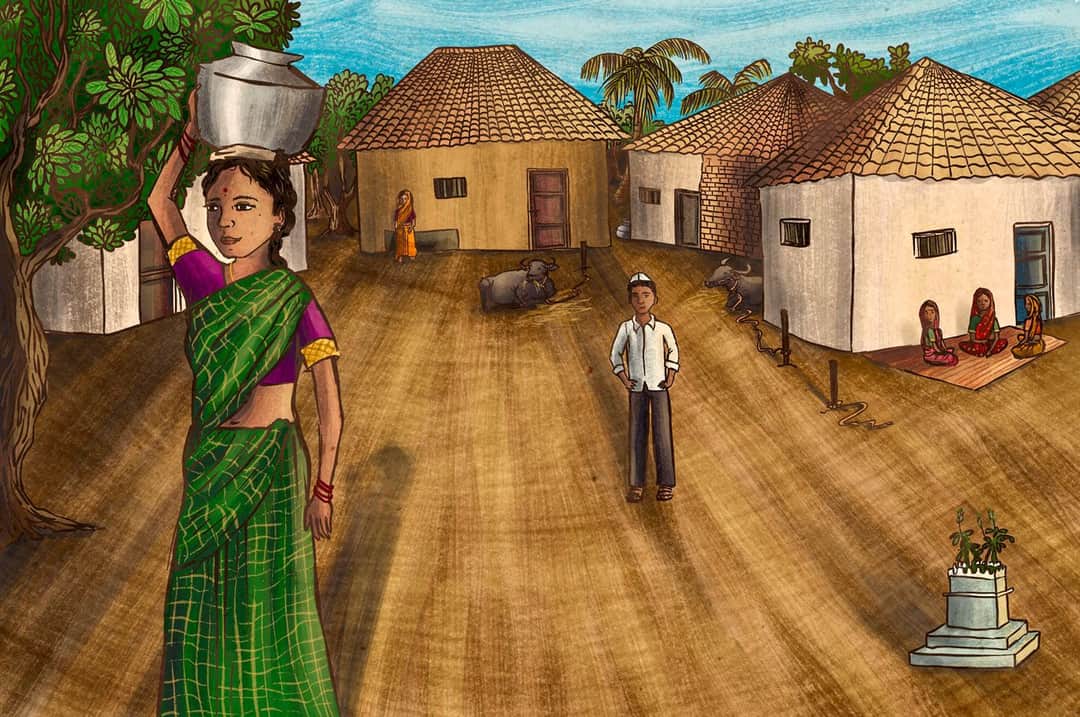


Three women from Mulshi taluka in Pune sing grindmill songs about the impact of a young and attractive woman’s behaviour on a married woman’s husband or son. They see in her a threat to their own happiness
Patriarchal society doesn’t just oppress women, it constantly pits them against one another. The grindmill songs cover a wide range of experiences of women who live in rural communities where the framework of patriarchy dictates every aspect of life. The women who sing these songs cry out in protest against society’s norms, where the birth of a girl child is a calamity for the parents. Their songs question why, when the sons and daughters are like oranges of the same tree, their treatment differs – and why the work that a woman performs holds no value. And yet, there are also songs which present marriage as the ultimate goal, the route to happiness for women.
The grindmill songs are a fine example of a cultural practice that connects and divides women, reproduces and questions a social order, and liberates and conditions a generation of singers and listeners. It is in this environment that friendship and a sense of sisterhood among women is celebrated – as many of the songs do.
However, there are also grindmill songs that reveal rivalries between women and reflect on them. Often, rivalry is presented as jealousy arising from women sharing the influence on a man – either a husband or a son. They give a succinct picture of the vulnerabilities that mark the lives of women, whose very existence depends on the recognition and attention that they get from the men in the family – a father or brother, and, as in the songs presented here, a husband and son.
In these ovi, an older, married, and therefore a respectable woman, is placed against a younger, unmarried woman who is looked upon with suspicion, especially because she is both attractive and outgoing. In the first three ovi, a woman – younger – is accused of indecent behaviour. To describe her actions, the verse alludes to a Marathi proverb: “A slanderous woman has let the water from the eaves seep into the thatched roof of a home.” Her wicked deeds are said to be so many that “a pot of water has been emptied … [and] the woman has slipped a tortoise into the well water.” The phrases imply the deliberate nature of her behaviour that destroys the happiness of another woman.