

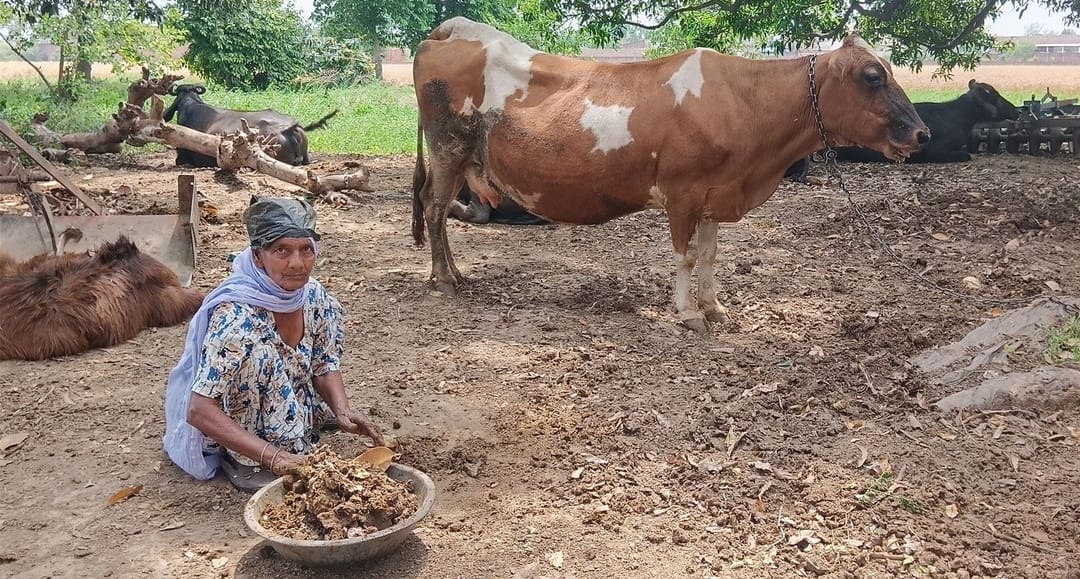
Amarjit Kaur freezes mid-way, the tasla – a metal basin that she is trying to hoist on her head seems a bit unsteady for a few seconds. Then slowly, she begins to walk in small, wobbly steps towards the rudi – the dung heap, to empty yet another lot she has gathered from the buffalo enclosure. There were days when she was able to walk with the tasla filled to its full capacity, some 10-12 kilograms, on her head. But at 72 that is hard. Though today the grief in her heart weighs heavier than the vessel on her head, slowing her down.
What I thought was an innocuous question about her family, had brought on a tsunami of memories dragging Amarjit 24 years into the past. “Unhan dasya Patti mod te tera munda mar gaya accident naal [They came and told me, ‘your son died in an accident at the turn near Patti’]," she says and sits down to gather more dung. Her hands move mechanically, her knees creak as she squats on her haunches on the floor. “He used to pull a rickshaw. He was just 18.” Five years later she lost her second son at 21.
The boys were merely six and four years old when their alcoholic father died 36 years ago. If it were not for goha-kura (cattle dung collection) that Amarjit had been doing since her marriage, she wouldn’t have been able to raise her boys and two girls (now married). She scoops more dung with bare hands along with the grief that has resurfaced, emptying one handful at a time into the basin. She heaves one long sigh as she lifts the vessel onto her head, and totters to the rudi, about 100 metres away. This is for the 20th time since she started cleaning this morning. She belongs to the Mehre Sikh community listed as a Scheduled Caste in Punjab. A landless Dalit, Amarjit picks up goha-kura in seven houses in Patti town for a living.
“Jadon main dangran da goha chukkan thalle behndi aan tan oh aksar mere sir te hi moot dindian ne. Main roz roz sir nhi dho skdi te shampoo saban da kharcha vi nhi chukk skdi. Is lai aah lifafa pa leni aan [I have to wrap this plastic bag on my head because often while I am scooping the dung, buffaloes urinate on me. And I can’t wash my hair every day and pay for soap and shampoo].” Amarjit shows me the black bag she is now holding in her fist. She has just finished working in the first house of the day. That of a landowning farmer with 10 buffaloes. She will now walk to another house from here.


