
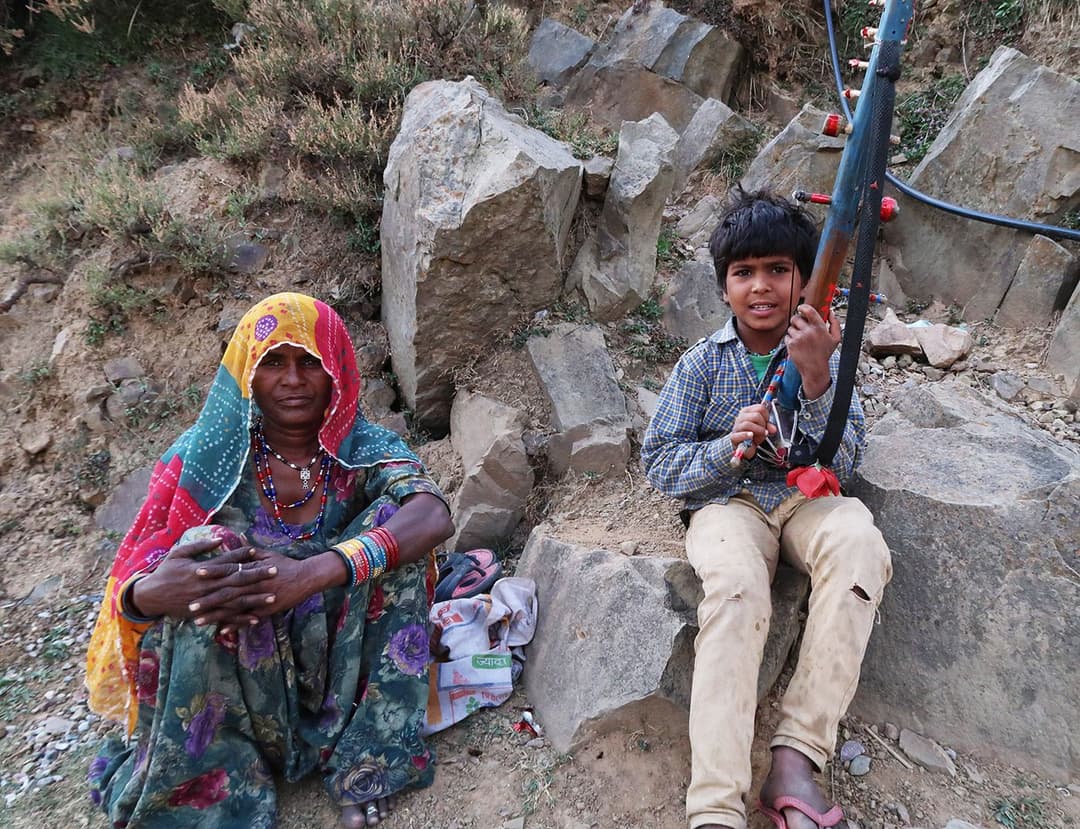
“Every year we come here for a month in the summer to earn some money,” says Shanti, as she pulls her colourful dupatta closer to her forehead and nudges her nine-year-old grandson Amarjeet to continue playing the ravanahatha. “Bajao, bajao [play it, play it],” she tells him. He moves the bow over the strings, but without much enthusiasm.
We meet Shanti and Amarjeet (in the cover photo on top) on our way to a mountain-view point; they’re sitting on a raised platform by the side of the road in Naddi village, around three kilometres from Mcleodganj in Himachal Pradesh, a little above Dharamshala.
Shanti tells us, a little apologetically, that “the boy’s [Amarjeet’s] grandfather is very good at playing the ravanahatha, but he is sick today so could not make it. We have always played this instrument and sung songs too. But my grandson does not like [to play] it. These days, they say children should study. So he goes to the school [in our village].”
Which class are you in, I ask Amarjeet. “Chouthi mein [in the fourth],” he answers with a smile.
The ravanahatha – literally, ‘ the hand of Ravana’ – is a two-stringed instrument. It has a bowl at one end made of coconut shell and goat hide. The player holds the half-coconut end against his midriff and points the long bamboo stick outward. There is one metal string along the length and one made of animal hair. The bow is moved across them to make music.
