

“You must always take them with something sweet like honey or jaggery,” says Urmila Dugga, rural health organiser, watching Suhani, three years old, lying listless in her grandmother’s lap.
It takes the combined skill and loving persuasion of three women – the child’s maternal grandmother, another rural health organiser (RHO) Savitri Nayak, and Manki Kachlan, the mitanin (ASHA worker) – to get the bitter malaria pills down the toddler’s throat.
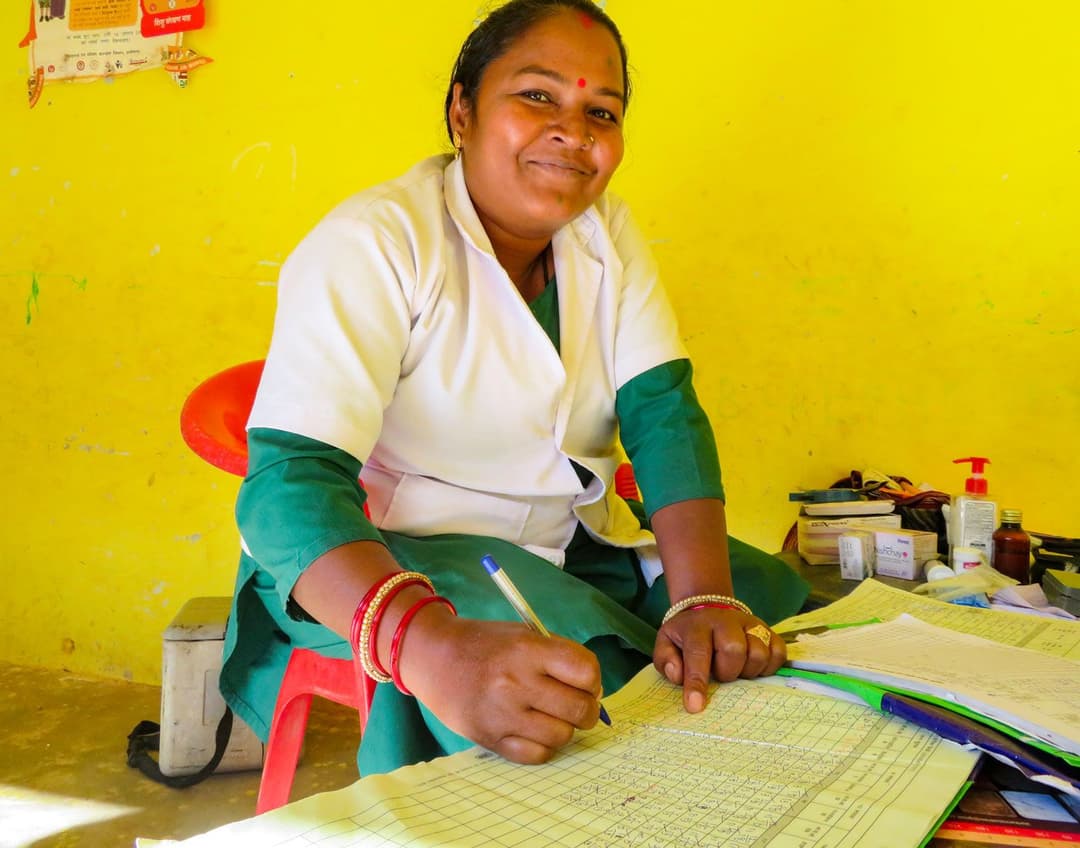
Supervising the process, 39-year-old Urmila, the senior RHO, notes down the details of the case in a large register amid sounds of children playing in the compound in front of her. Her makeshift clinic is a partially covered verandah of an anganwadi in Naumunjmeta village of Chhattisgarh’s Narayanpur district.
On every second Tuesday of the month, the anganwadi doubles up as an outpatient clinic – with kids busy learning their alphabets while mothers, infants and others line up outside for check-ups. Urmila and her team of health workers arrive around 10 a.m., unpack their registers and bags with testing and vaccination equipment, shift a table and bench into the verandah, and get ready to meet their patients.
Suhani’s rapid diagnostic test (RDT) done that day is one of the roughly 400 malaria tests that Urmila and her colleagues, including RHO Savitri Nayak, 35, conduct in a year in the six villages in Narayanpur block that they are in charge of.
“Malaria is one of our biggest health problems,” says Dr. Anand Ram Gota, the chief medical health officer for Narayanpur district. “It affects the blood cells and the liver causing anaemia, and in turn leads to poor physical stamina. So wages also get impacted. Children are born with low birth weight and so the cycle continues.”


