

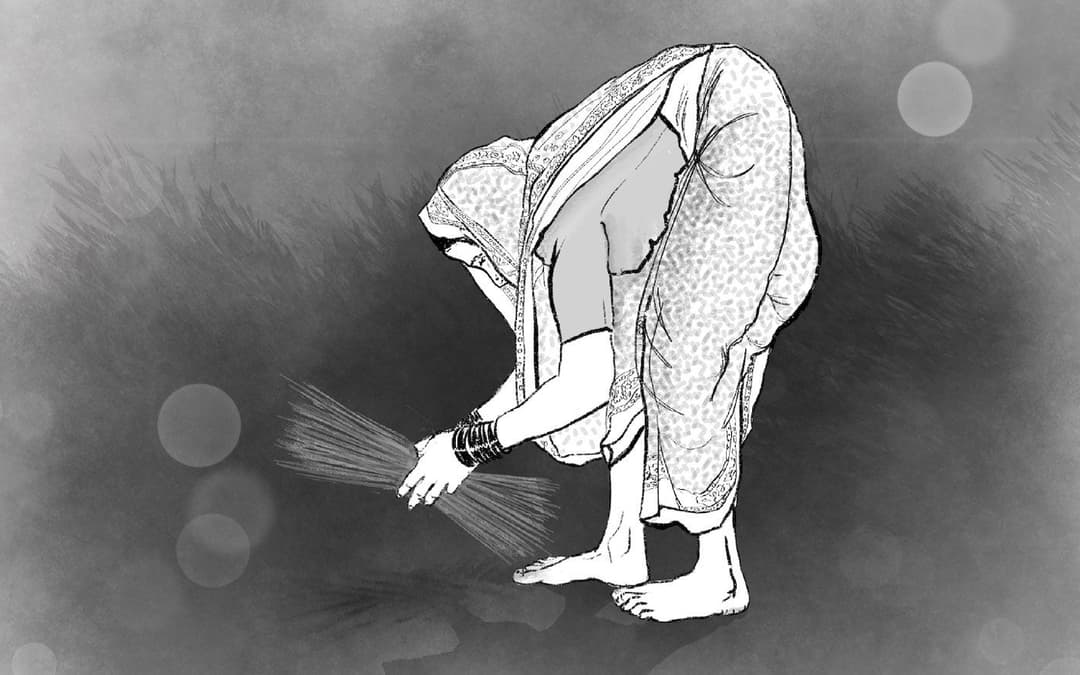
“What can I tell you? My back is broken and my rib cage is protruding,” Bibabai Loyare says. “My abdomen is sunken, my stomach and back have come together over the last 2 or 3 years. And the doctor says my bones have become hollow.”
We are sitting in a dimly lit kitchen, made from tin sheets, adjacent to her house in Hadashi village in Mulshi block. Bibabai, around 55 years old, is heating leftover rice in a pan over a mud stove. She gives me a wooden paat (low platform) to sit on and continues with her chores. When she gets up to do the dishes, I see that she is bent so completely from the waist that her chin could almost touch her knees. And when she sits with her legs drawn up, her knees touch her ears.
Osteoporosis and four surgeries in the last 25 years have left Bibabai this way. First, she went through a tubectomy procedure, then a surgery for hernia, followed by a hysterectomy, and then an operation that excised part of her intestines, abdominal fat and muscles.
“I was married at 12 or 13, just as I came of age [had her first period]. I did not conceive for the first five years,” says Bibabai, who didn’t get to go to school at all. Her husband, Mahipati Loyare – or Appa, as everybody knows him – is 20 years older than her and a retired zilla parishad school teacher, who was posted in various villages in Mulshi block of Pune district. The Loyare family cultivates rice, Bengal gram, beans and legumes on their farmland. They also have a pair of bullocks, a buffalo and a cow and her calf, and milk fetches them an additional income. Mahipati also gets a pension.
“All my children were born at home,” Bibabai continues. Her first child, a boy, was born when she was just 17. “We were on our way to my parents' home [in a village “beyond the hill range”] in a bullock cart as there was no pucca road and no vehicles in our village at the time. My water broke, I went into labour, and soon my first child was born, right there in that bullock cart!” Bibabai recalls. She needed an episiotomy later to repair the perineal tear – she does not recall where this was done.


