
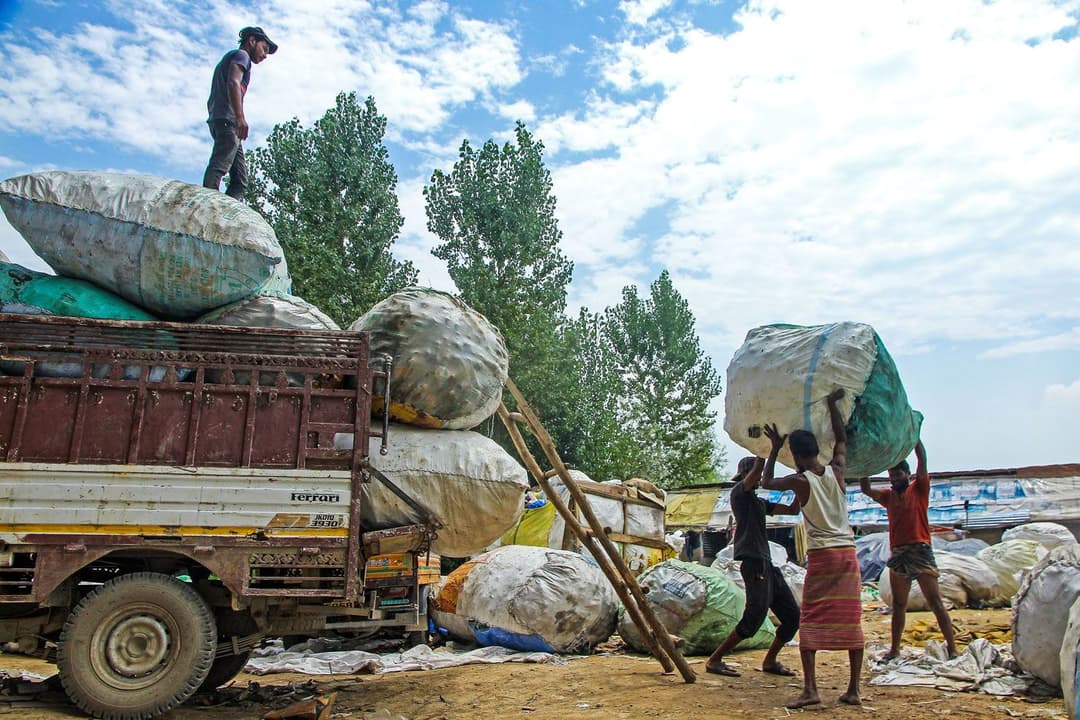
Every morning, the entire Sheikh family sets out to work. Fatima leaves her home in a slum colony in the Batamaloo area of central Srinagar at 9 a.m. and till around 5 in the evening she cycles roughly 20 kilometres within the city to collect discarded plastic bottles and gatta (cardboard). Her husband, Mohammad Qurban Sheikh, sometimes goes further, beyond city limits, to towns and villages within a 30-kilometre radius looking for discarded items – using, like Fatima, a three-wheel cycle-rickshaw with a tempo-like container at the back. Their daughter and two sons, ages ranging from 17 to 21, also collect waste in Srinagar.
Together, the five help clear a fraction of the 450-500 tons of garbage that Srinagar's households, hotels, construction sites, vegetable mandis and various other locations produce every single day – that’s the number given by the Srinagar Municipal Corporation.
The Sheikh family – and numerous other waste-pickers – are not formally linked to the waste management processes of the municipal corporation, which employs, says municipal commissioner Athar Amir Khan, around 4,000 sanitation workers either full-time or on contract to collect and dispose the city’s solid waste. “Rag-pickers though are our best friends,” says Nazir Ahmad, chief sanitation officer, Srinagar Municipal Corporation. “They take away plastic waste which cannot decompose even in 100 years.”
The rag-pickers are not only ‘self-employed’, they work without any protective gear in very hazardous conditions – made even more unsafe due to the Covid-19 pandemic. “I resumed work [after the lockdown eased in January 2021] keeping faith in god. I work with pure intentions to feed my family and know I will not get infected…” says 40-year-old Fatima.


