

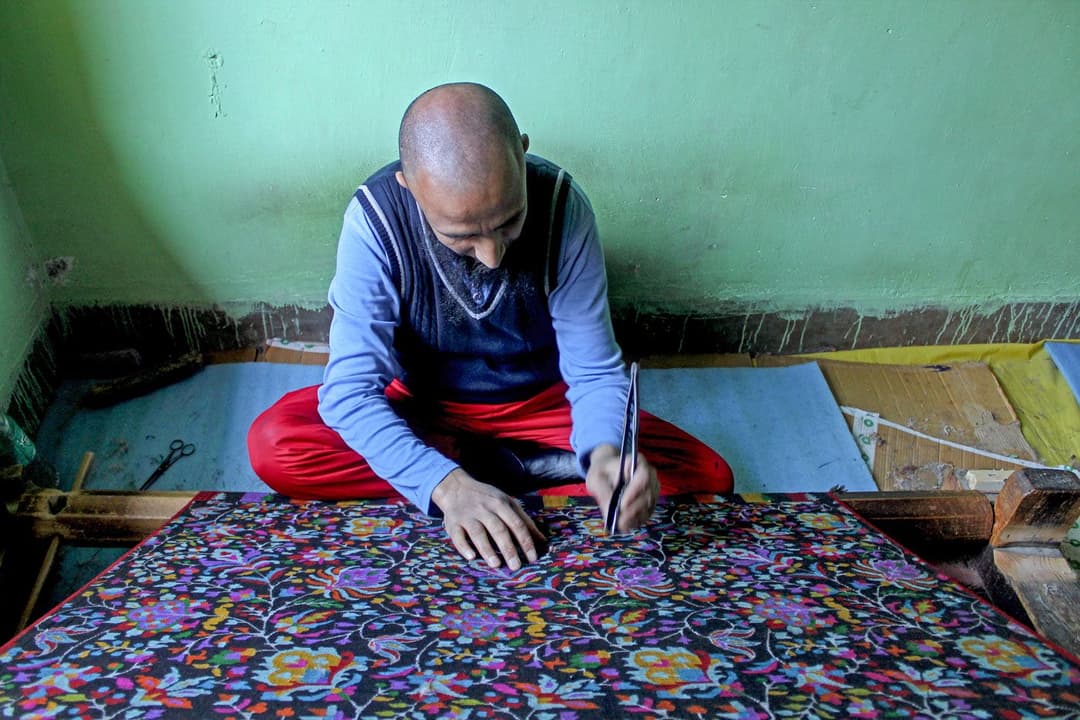
"It is we who give pashmina shawls their silky finish.”
Abdul Majeed Lone's house in Srinagar is littered with tangles of thread. Sitting on the floor, a wouch (a sharp iron tool) in hand, he dexterously plucks stray threads and lint off a freshly-woven pashmina shawl. “Very few people know that a craft like ours exists,” he says.
The 42-year-old craftsman lives in Nawa Kadal ward in Srinagar district. He uses a wouch to manually pluck purz (lint or threads) off high-value pashmina shawls. This work is called purazgari and there are more than 200 such craftspeople working in Srinagar alone. Abdul has been a purazgar craftsman for two decades now, earning roughly Rs. 200 for eight hours of work.
For all kinds of pashmina shawls – woven, dyed and embroidered – purazgari is done manually. The delicate nature of the fabric does not allow for any machine to substitute for the craftsperson's skill.
A wouch is essential to purazgari. “Our entire earning depends on a wouch and its quality,” Abdul says, peering intently at a shawl that is tautly stretched across the wooden loom in front of him. “It is difficult for us to refine a pashmina shawl without a wouch.”


