

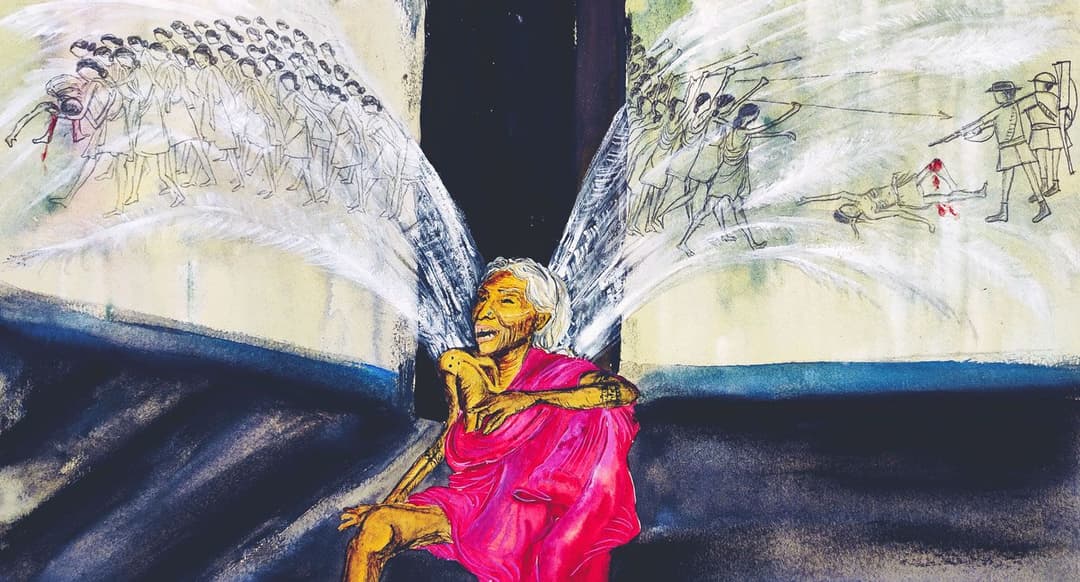
As the sun sets behind the rugged hills of the Eastern Ghats, the shrill calls of the hill mynah in the adjacent forest are crushed under the heavy sounds of boots of the paramilitary forces. They are patrolling the villages once again. It is the evenings that she fears the most.
She does not know why she was named Demathi. “She was a fearless woman from our village, who chased the British troops away, all alone,” mother would tell the story, excitedly. But she was so unlike Demathi – she was timid.
And she learned to live with a stomachache, hunger, without much water, without money in the house for days, with suspicious eyes, threatening stares, regular arrests, torture, people dying. But all through, she had the forest, the trees, and a spring by her side. She could smell her mother in the saal flowers, hear her grandmother’s songs echo in the forests. As long as she had them, she knew she would survive her troubles.
But now they wanted her out, out of her hut, her village, her land – unless she could show a paper that proved all that she knew. It was not enough that her father had taught her the names of various trees and shrubs, barks and leaves, that all had healing powers. Every time when she went with her mother to collect fruits, nuts and firewood, her mother showed her the tree under which she was born. Her grandmother had taught her songs about the forests. She had run around the place with her brother, watching birds, echoing their calls.
But can such knowledge, these stories, songs, and childhood games, be proof of anything? She sat there wondering about the meaning of her name, and about the woman after whom she was named. How would Demathi have proved that she belonged to the forest?