

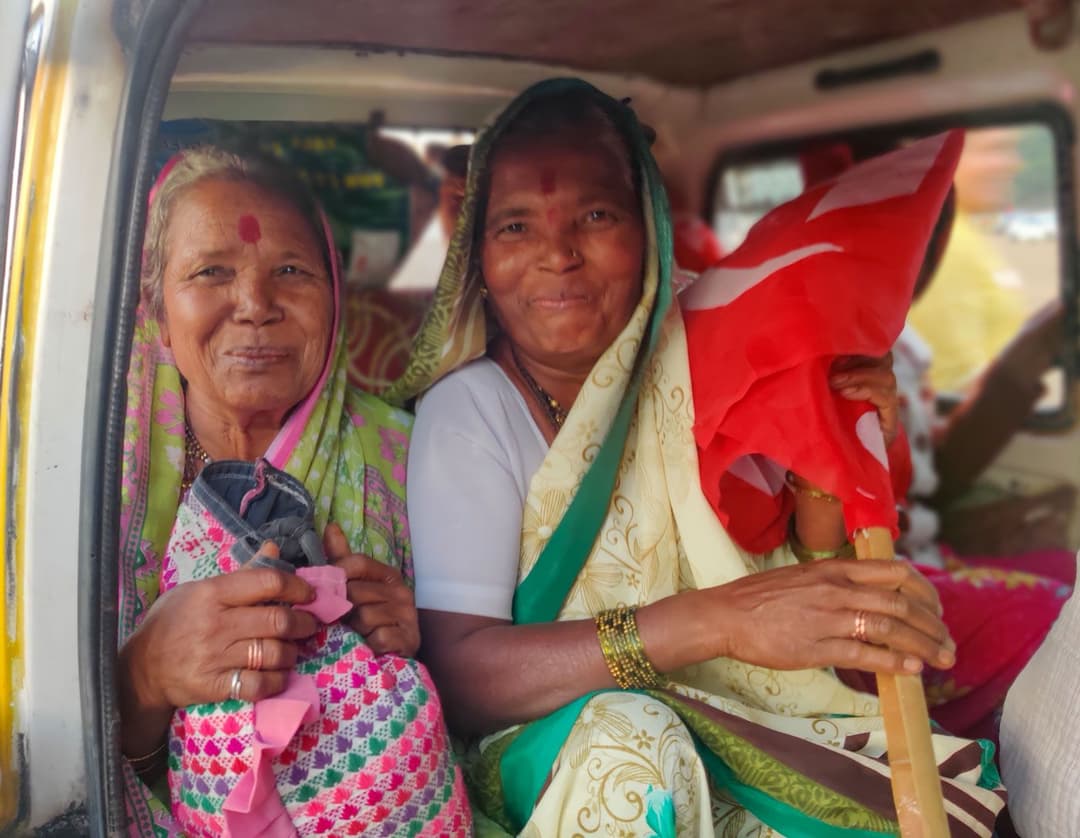
The Maruti van is full and ready to move. The farmers have occupied every available corner, some are even sitting in each other’s laps. Their bags and walking sticks are cramped in a sliver of space beyond the backseat.
But one seat next to Mangal Ghadge is conspicuously empty. She does not allow anyone to sit there – it’s ‘reserved’. Then Mirabai Lange walks up to the van, sits in that empty space and adjusts her saree, while Mangal puts her arm around her shoulders. The door shuts, and Mangal tells the driver, “Chal re [Let’s go].”
Both Mangal, 53, and Mirabai, 65, are from Shindwad village in Nashik’s Dindori taluka. However, it’s not their decades in the same village but the last few years that have cemented their bond. “We are busy with work and home in the village,” says Mangal. “At protests, we have more time to chat.”
The two were together during the Kisan Long March from Nashik to Mumbai in March 2018. They travelled together to Delhi in November 2018 for the Kisan Mukti Morcha. And now, they are at the jatha, a vehicle rally from Nashik to Delhi. “Pota sathi [for our stomachs],” Mangal says, when I ask her why she is participating in this protest.
Tens of thousands of farmers are protesting at three different sites along the borders of the national capital against the three farm laws pushed through by the central government in September this year. To express their support and solidarity, on December 21, about 2,000 farmers from Maharashtra assembled in Nashik to participate in the jatha going all the way to Delhi, roughly 1,400 kilometres away. They have been mobilised by the All India Kisan Sabha, affiliated with the Communist Party of India (Marxist).
Mangal and Mirabai are among this band of spirited protestors.


