

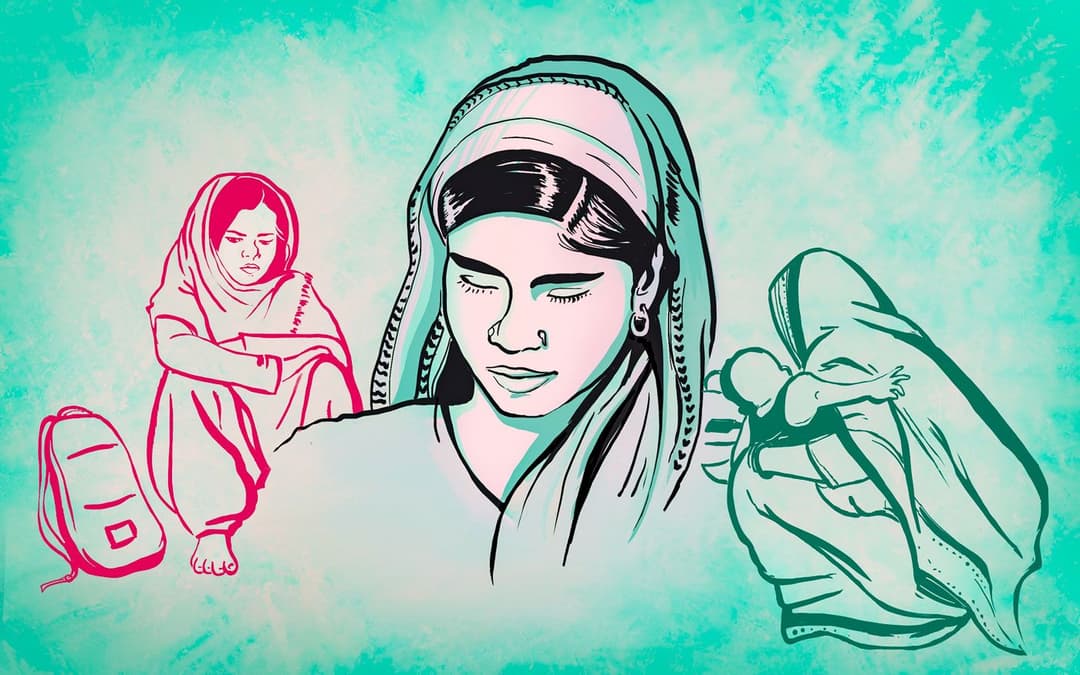
Both are 17, both are pregnant. Both of them collapse easily into giggles, sometimes forgetting parental instructions to keep their gaze down. And both are terrified of what comes next.
Salima Parveen and Asma Khatun (names changed) were both in Class 7 last year, though the government-run village school was closed right through the academic year of 2020. As the lockdown wore on, the men in their families who had been away working in Patna, Delhi and Mumbai came home to Bangali Tola, a hamlet in Bihar’s Araria district. A small flurry of matrimonial alliances followed.
“Corona mein hui shaadi,” says Asma, the more talkative of the two. “I got married during corona.”
Salima’s nikaah (wedding ceremony) had been solemnised two years earlier, and she was to begin to cohabit with her husband when she was closer to 18. Then the lockdown hit, and her 20-year-old husband, who works as a tailor, and his family – they live in the same hamlet – insisted that she move in. That was around July 2020. He was without work and at home all day, the other men were at home too – and an extra hand would be useful.
Asma had even less time to steel herself. Her 23-year-old sister died of cancer in 2019 and in June last year her sister’s husband, a plumber, insisted on marrying Asma during the lockdown. The ceremony took place in June 2020.
Neither girl knows how babies are born. “These things are not explained by the mother,” says Rukhsana, Asma’s mother, as the girls giggle some more. “Laaj ki baat hai [It is an embarrassing matter].” Everybody agrees that the bride’s bhabhi, her brother's wife, is the correct source of this and other information, but Salima and Asma are sisters-in-law and neither is in any position to offer child-bearing advice.


