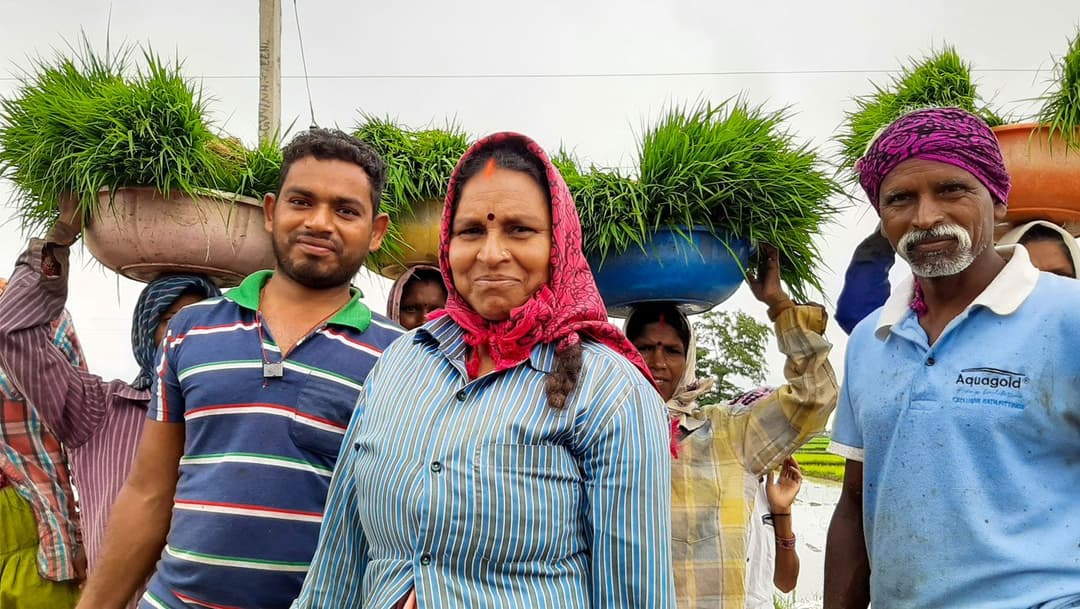
On another day around mid-July, on the Koliyari-Kharenga village road, around 15 kilometres from Dhamtari town, we met another group of farm labourers. “If we don’t work, we will die of hunger. We cannot afford the luxury of staying safe at home [due to the risk of Covid-19],” said Bhukhin Sahu from Kharenga village of Dhamtari block. She is the leader-contractor of a group of 24. “We are labourers and we have only our hands and legs. But while working, we are maintaining physical distance…”
She and the others were sitting on both sides of the road and eating a lunch of rice, dal and sabzi, which they had brought from home. They wake up at 4 a.m., cook, compete household tasks, have a morning meal and reach the field at around 6 a.m. They return home 12 hours later, by 6 in the evening. Then cook again and do other work, said Bhukhin, about her and the other women’s work day.
“We plant about two acres every day, and get 3,500 per acre,” Bhukhin said. This per-acre group rate varies, from Rs. 3,500 to Rs. 4,000 (this season, in Dhamtari) and depends on negotiations and the number of workers in a group.
Bhukhin’s husband went to Bhopal some years ago to work as a labourer and never returned. “He left us behind in this village. He is not in contact with us,” she said. Her son is in college, and Bhukhin’s is the only income that sustains her family of two.
On the same road, we met another group of farm labourers – most of them women, a few men – carrying paddy saplings to a field for planting. “This is our source of livelihood. So we have to work. If we don’t work, who will produce the harvest? Everyone needs food to eat,” said Sabita Sahu, a contractor from Darri village of Dhamtari block. “ If we will fear corona, we will not able to work at all. Who will then feed our children? And our work is such that we maintain distancing anyway [in the paddy fields].” By mid-July, when I met them, Sabita and her group of 30 had planted paddy saplings in 25 acres to earn Rs. 3,600 per acre.