

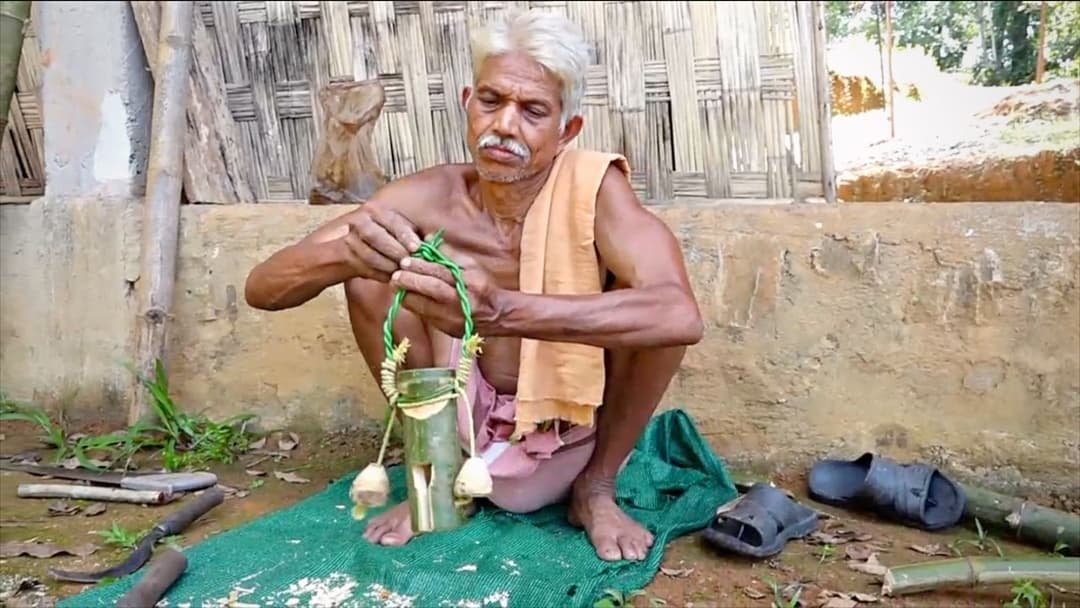
The tain-tain-tain sound of cowbells is now hardly heard in the undulating and hilly terrain of Beltangadi taluk in Dakshina Kannada district. “No one is making these bells anymore,” says Hukrappa. But it isn’t the common cowbell he’s talking about. In his village, Shibaje, the bell tied around a cattle’s neck is not made of metal – it is handmade with bamboo. And Hukrappa, an areca nut farmer in his late 60s, has been crafting the unique object for years.
“I was a cattle grazer before,” Hukrappa says. “We would lose track of the cows sometimes, and so the idea of making cowbells with bamboo came up.” The sound of the bells would help them locate the cows that wandered away in the hills or strayed into others’ farms. So when an elderly man in the village offered to teach him the craft, he started out by making a few. In time, he became skilled at making bells of varying sizes. It helped that the bamboo was within easy reach – his village in Beltangadi falls in the reserve forest of Kudremukh National Park, in the Western Ghats of Karnataka, which is home to three species of the grass plant.
Called ‘bomka’ in Tulu, the language Hukrappa speaks, the bamboo cowbell is known as ‘monte’ in Kannada. It has a special significance in the cultural life of Shibaje, where the Durga Parameshwari temple is known for the tradition of offering montes to the deity. The temple precinct is even called ‘Montethadka’. Devotees pray for their cattle’s protection and to have their wishes fulfilled. Some of them get the bamboo cowbells made to order from Hukrappa. “People buy this for harke [votive offering]. When a cow doesn’t produce a calf [for example], they offer it to the deity,” he says. “They pay up to 50 rupees for a piece. The larger bells sell for up to 70 rupees.”