
On a bright and sunny day, 39-year-old Sunita Rani is speaking to a group of around 30 women, exhorting them to come out in large numbers and sit on an indefinite strike for their rights. “Kaam pucca, naukri kacchi [Assured work, unsure pay],” Sunita hollers. “Nahin chalegi, nahin chalegi [This can’t go on, this can’t go on]!” the other women chant in unison.
On a patchy lawn outside the Civil Hospital in Sonipat town, off the Delhi-Haryana highway, the women, dressed in hues of red – their uniform in Haryana – sit on a dhurrie and listen to Sunita as she lists the woes they know all too well.
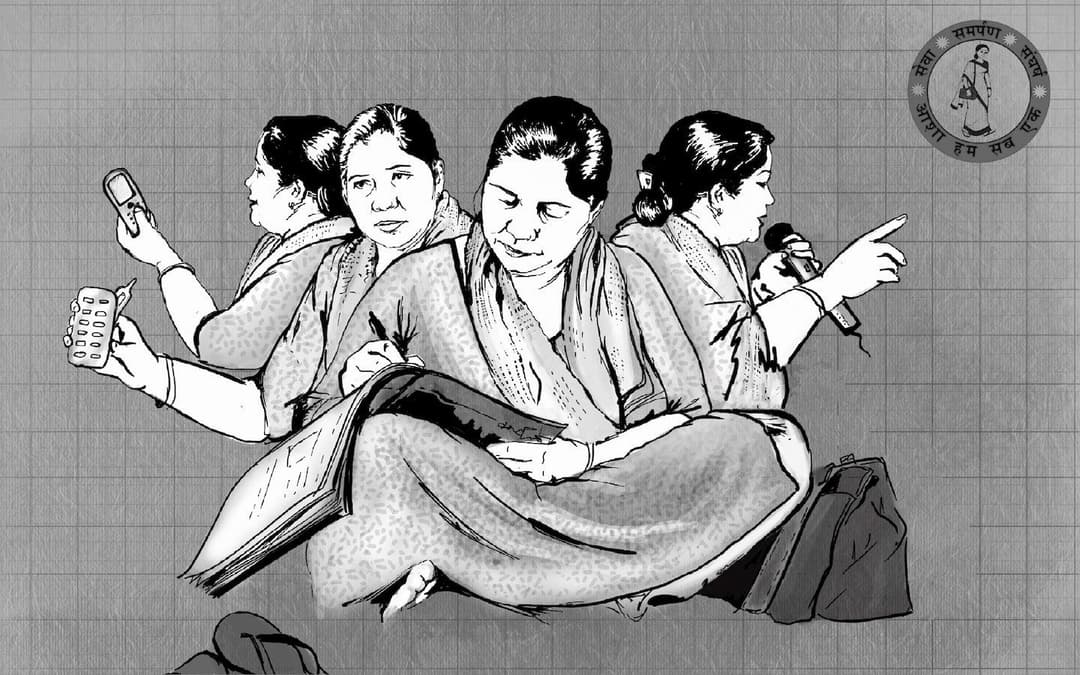
The women are all ASHAs, Accredited Social Health Activists, foot-soldiers of the country’s National Rural Health Mission (NRHM), a critical link connecting India’s rural population to the country’s public healthcare system. Over 1 million ASHAs work across the country, and are often the first healthcare worker available for any health-related needs and emergencies.
They are required to perform a mind-boggling array of 12 primary tasks and over 60 sub-tasks, ranging from disseminating information about nutrition, sanitation and infectious diseases to tracking treatment of tuberculosis patients and maintaining records of health indicators.
They do all this and more. But, says Sunita, “What gets left behind is what we are actually trained for – improving maternal and neonatal health statistics.” Sunita works in Sonipat district’s Nathupur village, and is one of three ASHAs in the village taking care of a population of 2,953 people.


