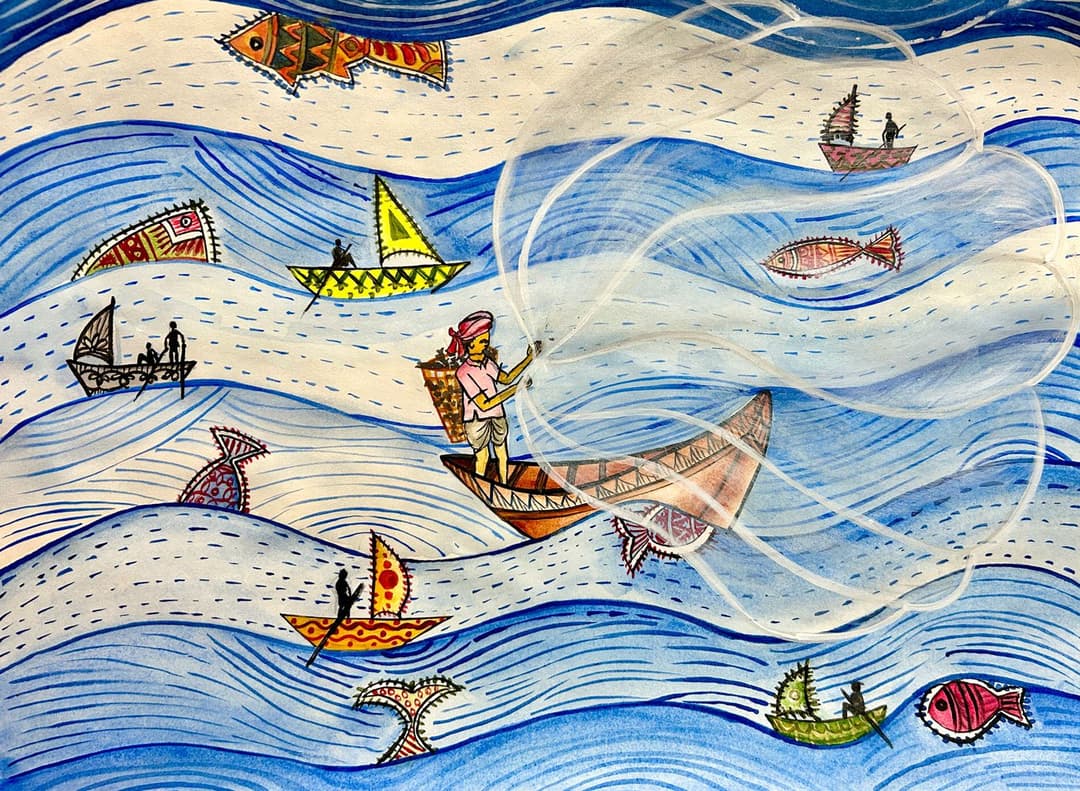

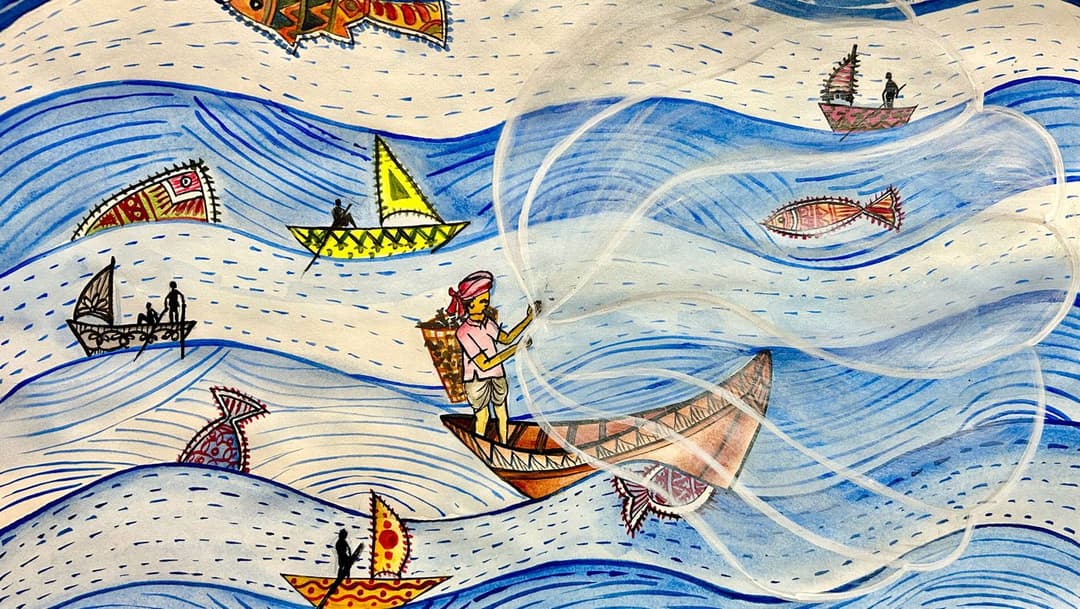
Agricultural labourers working in the field. Or maybe a group of salt-pan workers, or a few miners, or fishermen on their boats, bursting into song while labouring, is not a surprising sight. In traditional cultures, hard physical work has often been accompanied by songs about specific occupations or forms of labour. Occupational folk songs have existed across cultures. Sometimes, they encourage and coordinate a group of people working together. Sometimes they relieve the boredom and pain of a wearying job.
The 170-metre long Gulf of Kachchh, a vast intertidal zone with a network of creeks, estuaries and mudflats, houses a large ecosystem and is a breeding zone for many marine organisms. Fishing has been a traditional occupation for many in the coastal region. The song here speaks of the challenges faced by the fishing communities whose livelihoods are being steadily eroded by waves of coastal development activities.
Unions of fisherfolk in Kachchh, academicians, and others have reported the adverse impact of these activities. They have blamed the Mundra Thermal Plant (TATA), and the Mundra Power Project (Adani group) for the rapid decline of marine diversity, which in turn affects the fishing communities in the area. The song presented here, utterly simple in its language, hints at these challenges.
This work-song is beautifully rendered by Juma Vagher of Mundra taluka, a fisherman himself. He is the lead singer, and the chorus chants the refrain – ho Jamalo (hey, fisherfolk). The song’s captivating melody transports us to the fast-changing, distant shores of Kachchh.