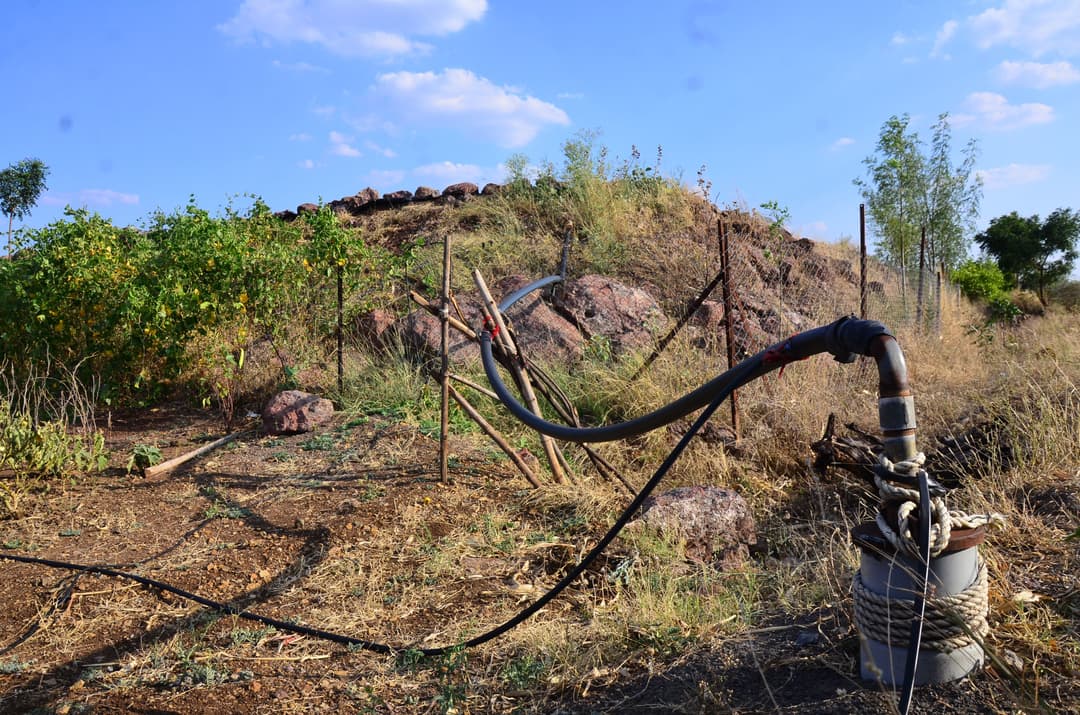


BEED: In his village he is known simply as the "borewell man". In the parched Ashti taluka, everyone seems to know the way to Vishwambar Jagtap's home. The pomegranate farmer is a local celebrity in drought-hit Beed, for good reason. He has as many as 48 borewells on his farm.
Some of these go as deep as 1,000 feet. That's more than the length of a 60-storey skyscraper in Mumbai.
"This year I have sunk only one borewell," says Jagtap good-humouredly. He is among the large land-holders here, with an 18-acre plot.
Since 2005, Jagtap has steadily drilled borewells to keep his farm going in this rain-starved and non-irrigated belt. But they tap into the same source of groundwater and fail within months. "Only 15 of my 48 borewells are working," he confesses.
It's an enterprise on which Jagtap has spent lakhs. Each borewell, drilled mostly by rig-operators based in the South, costs a base price of Rs 75,000. The price goes up the deeper you drill, he says.
To identify the spot, he relies on the local panadi or water diviner. This involves an elaborate ritual where a coconut is expected to magically spin in the direction of the water. "I saw it with my own eyes once. But there was no water," he admits.
Water table dips
The water crisis in the region has pushed thousands towards the unregulated borewell industry, draining groundwater and posing an ecological disaster. The water table in 61 of the 76 talukas in Marathwada has dipped in the last five years. At least 25 talukas show a depletion of one to two metres.
Across the state, there are over 2 lakh irrigation borewells and 1.69 lakh domestic borewells, according to a 2011 report of the Groundwater Survey and Development Agency.