The People’s Archive of Rural India is proud to unveil this testament to the tenacity and artistry of the women of rural Maharashtra on our website. This launch honours International Women’s Day, March 8, 2017.
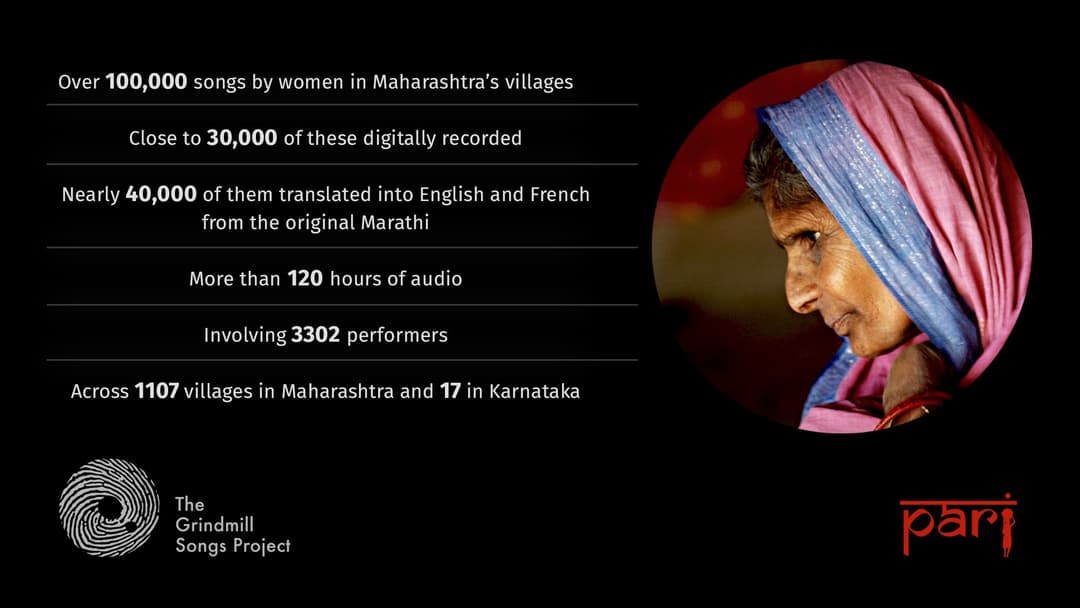
The grindmills songs database was conceived by the late Hema Rairkar and Guy Poitevin , social activists and distinguished scholars, who co-founded the Centre for Cooperative Research in Social Sciences in Pune. Together they transcribed more than 110,000 folk songs of Maharashtra over a period of 20 years.
Bernard Bel , a computational musicologist and former engineer at the French National Centre for Scientific Research, joined the project in the late 1990s, architecting a database of texts and annotations and recording more than 120 hours of associated audio. This material was maintained by the Archives and Research Centre for Ethnomusicology in Gurgaon, Haryana, and later ported to the Speech and Language Data Repository in Aix-en-Provence, France, also curated by Prof. Bel. There, the grindmill songs database became a prototype for later Open Archival Information Systems, and paved the way for many subsequent advances in the Digital Humanities.
Between 1993 and 1998, the Grindmill Songs Project received financial support from UNESCO, the Netherlands Ministry for Development Cooperation, and the Charles Leopold Mayer Foundation for the Progress of Humankind in Switzerland.
“I had a personal commitment with Hema Rairkar and Guy Poitevin to complete the documentation/ edition/ translation of the grindmill corpus and publish it in open access,” says Prof. Bel. “In January 2015, their project was revived as I donated equipment to the team of grindmill song experts working in Pune. We worked together on an initial publication format for the corpus. This required a serious investment in re-engineering the database and transcoding texts from several Devanagari encodings.”
With PARI's involvement, the project has been recently revived together with a host of old and new collaborators. The 70,000 untranslated songs are being tackled by Asha Ogale, a former documentation officer at the Gokhale Institute of Politics and Economics, Pune, and her colleagues Rajani Khaladkar and Jitendra Maid. Their deep collective knowledge of the Marathi language and rural life lends invaluable context to the translation effort.
A partnership with Ashoka University in Sonepat, Haryana, was established in 2016, led by Gilles Verniers, Assistant Professor of Political Science at that institution. Three members of the 2016-17 Young India Fellowship class – Meherish Devaki, Sneha Madhuri and Poornaprajna Kulkarni – are reviewing the translations and providing additional archival assistance. Namita Waikar, Managing Editor, PARI, heads the Grindmill Songs Project at the People’s Archive of Rural India, while Olivia Waring, an American India Foundation Clinton Fellow, also contributes to database curation.
Among the many others significantly contributing to the project were Bhimsen Nanekar (interviewer), Datta Shinde (research participant), Malavika Taludkar (photographer) Lata Bhore (data input), and Gajarabai Darekar (transcribing).
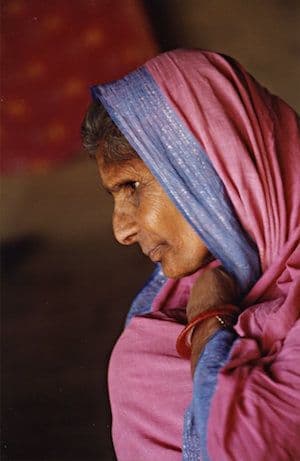
All selected videos and photographs of Gangubai Ambore, a central performer and participant in the project, are the work of Andréine Bel.
We invite you to explore this latest addition to the People’s Archive of Rural India, which will be incrementally unveiled over the coming months and years. PARI extends its heartfelt gratitude to all the Grindmill Songs partners – and especially acknowledges the lives and achievements of thousands of unsung women of rural Maharashtra, but for whom there would be no songs and no database.