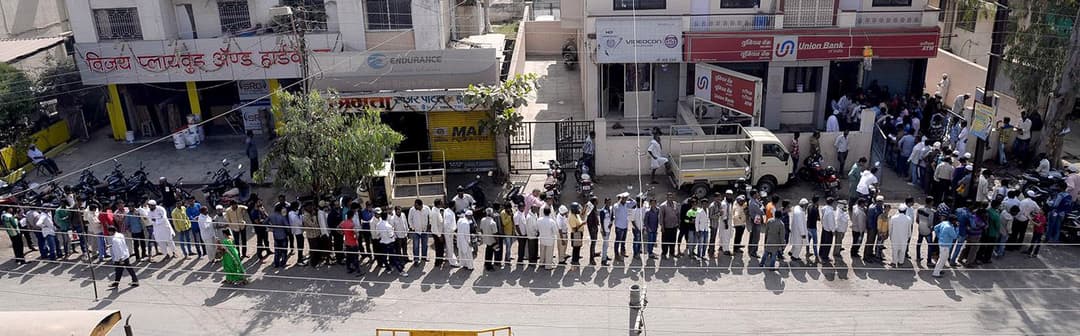
As several writers, analysts and official reports have already pointed out, the bulk of India’s ‘black’ economy is held in bullion,benami land deals, and foreign currency. Not in stacks of notes in grandma’s old oak chest. The chairman of the Central Board of Direct Taxes said so in a 2012 report on Measures to tackle black money in India and abroad . The report also said (page 14, Part II, 9.1) demonetisation “miserably failed" on two past occasions in 1946 and 1978. Yet, this action is what the Bharatiya Janata Party government has repeated. The ‘Modi masterstroke’, a term contrived by assorted anchors and other clowns on television to hail an unbelievably stupid action, is spreading agony and misery in its wake across the countryside. If there’s been any stroke, it’s the one the heart of the rural economy has suffered.
The recovery time from the stroke was first dismissed by the finance minister and his party colleagues as 2-3 days of discomfort. Dr. Jaitley then modified that to 2-3 weeks. Soon after, his senior surgeon, Narendra Modi, said he needed 50 days to restore the patient to health. So we’re already into 2017 with this course of treatment. Meanwhile, we do not know how many people across the country have died waiting in queues, but their number mounts daily.
“In Lasalgaon in Nashik district, farmers driven by the cash crunch closed down the onion markets,” says Nishikant Bhalerao, editor of the weekly Adhunik Kisan . “In Vidarbha and Marathwada, cotton prices have plummeted by 40 per cent per quintal.” Barring a few transactions, sales have come to a halt. “No one has any cash. Commission agents, producers and buyers alike are in serious trouble,” says Jaideep Hardikar, a reporter with The Telegraph in Nagpur. “Depositing cheques in the rural branches was always a tedious process and right now, withdrawal is a nightmare.”
So, very few farmers will accept cheques. How can their households function while waiting for those to be realised? Many others simply do not have active bank accounts.
One important public sector bank in this state has a total of 975 ATMs across the country. Of these, 549 were serving up no denomination other than despair. Most of those non-functioning ATMs are in rural areas. A particularly cynical rationalisation of the impact is the claim that “rural areas function on credit. Cash means nothing.” Really? It means everything.
Transactions at the lowest levels are overwhelmingly in cash. Bank employees in small rural branches foresee a law and order crisis if small denomination cash doesn’t arrive in a week. Others say the crisis is already here and will not abate even if some cash arrives in that time.
At another queue in Aurangabad, Pervez Paithan, a construction supervisor, fears his labourers will soon turn violent. “They need to be paid for work already done,” he says. “But I cannot lay my hands on cash.” In Chikalthana village, Rais Akhtar Khan says she and other young mothers like her are finding it increasingly difficult to feed their children. When they do, “it is after great delays because we are spending so much of our day in these queues. The children go hungry for hours after their normal eating time.”
Most women in the queues say they have 2-4 days of provisions left. They’re terrified to think the cash flow problem might not be resolved in that time. Alas, it will not be.
Farmers, landless labourers, domestic servants, pensioners, petty traders, all these and many other groups have taken a terrible hit. Several including those employing workers will go into debt, borrowing money to pay off wages. With some others, it’s to buy food. “Our queues are growing, not diminishing, with each passing day,” says a staffer at the Station Road branch of SBH in Aurangabad. Here a few employees are trying to cope with huge and increasingly angry queues of people. One staffer points out a flaw in the software sent out for the authentication of ID and other details.
People are allowed to exchange a maximum of eight notes of Rs. 500 or four of Rs. 1,000 for two of Rs. 2,000 in value. This is a one-time transaction. “Yes, it does trip you up if you try duplicating your act the next day. But you can get around that. Just use a different ID. If today you use your Aadhaar card, tomorrow bring your passport and the day after that, your PAN card, you can repeat the transaction without detection.”