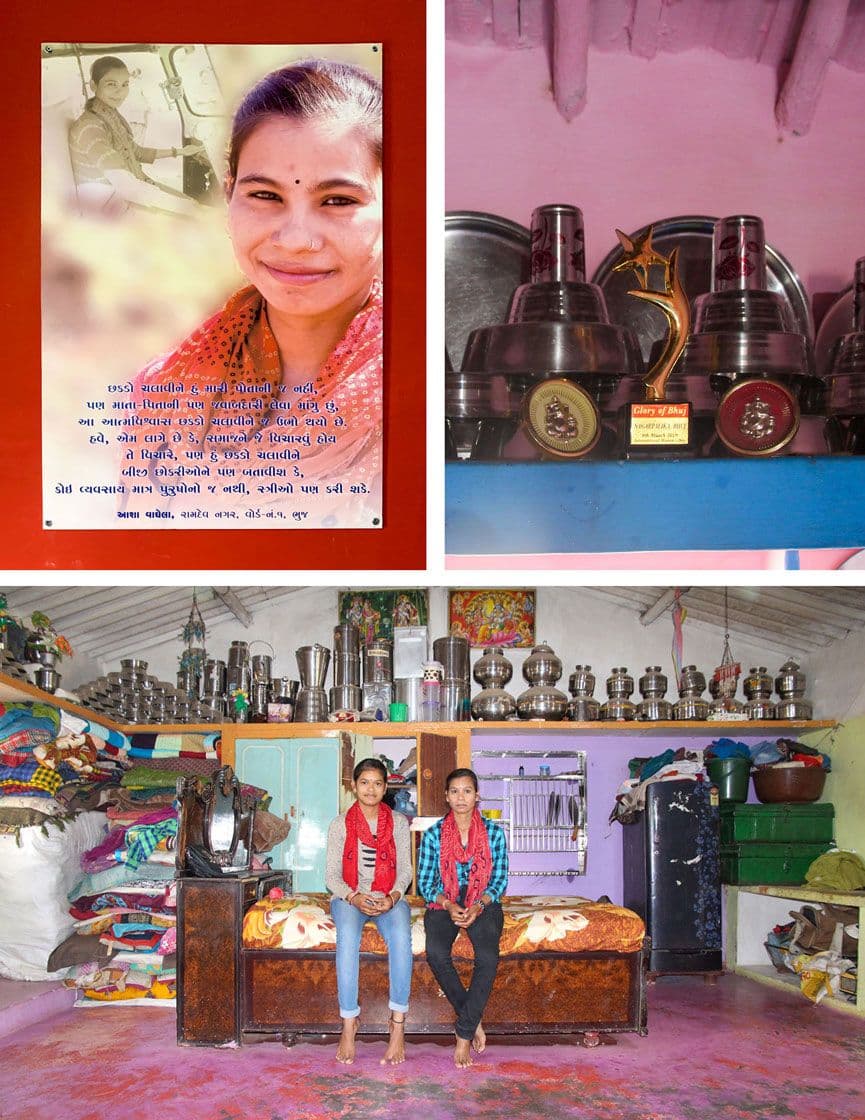


“Women even fly airplanes, then what’s so difficult about driving an autorickshaw?” asks Chandni Parmar. At just 20, she became the first woman autorickshaw driver in Bhuj city, in late 2018. A close second was Asha Vaghela, a year older, who happens to be Chandni’s maasi – that is, her mother’s youngest sister.
The vehicle they ply, popularly called chakado or chakada, is a large three-wheeler in which up to 10 people can comfortably sit. It is a common mode of transport for people travelling to and from villages up to 25 kilometres from Bhuj, the headquarters of Kachchh district in Gujarat. Since it runs without a taxi-metre, the fare is charged according to a rough, unwritten rate card. “We take Rs. 20-30 for short distances, more for longer rides,” says Asha. “It can even go up to Rs. 300 if we drive very far.”
At first, their families – especially Asha’s parents – were reluctant to let their daughters do what no woman in their family, or even in all Bhuj, had ever done before. In Chandni’s case, the economic needs of a large, growing family helped make her parents more willing to let her learn to drive the three-wheeler.
The oldest child in a family of four sisters, two brothers and their parents, Chandni drove me on a Sunday evening to her home in Bhuteshwar Nagar, a semi-rural colony beyond Bhuj railway station. The dirt path from the main road to her home is an uneven, bumpy ride. “No autowala will come here, except me,” she says, “so I get many customers going into town from around my home.”