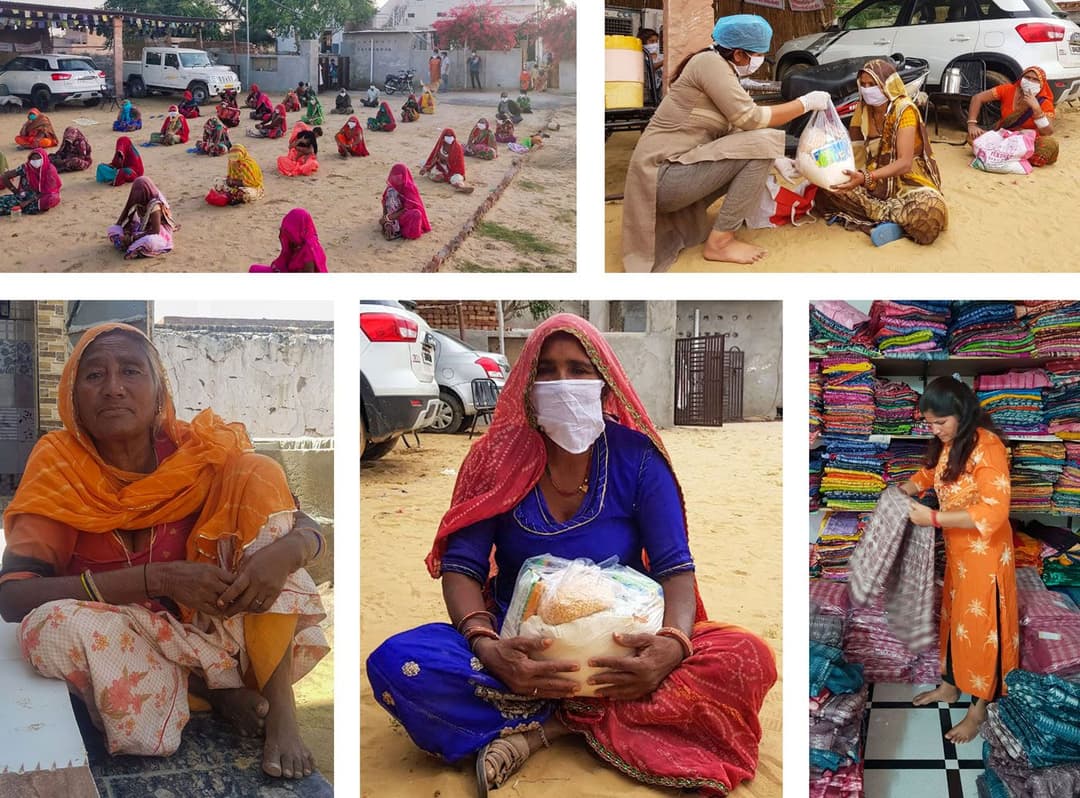


“Come and see us,” she says. “We are all following orders. Sitting here, far from each other, wearing masks. I am grateful for these rations, but it will only feed my family for a few days. After that, I don’t know what we will do.”
That’s Durga Devi, 55, speaking to us on the phone from Sujangarh town in Rajasthan’s Churu district, while waiting in line to collect free rations at Disha Shekhawati, the NGO where she works as a shibori artisan. Shibori is a fabric tie and dye technique, completely handcrafted. “We don’t know when we will get this corona, but we will die of hunger first,” says Durga Devi, laughing at her own dire prediction.
Durga Devi is the only working member in her family, after her husband died of alcohol abuse a few years ago. She is bringing up their nine children on her own. She earns a daily wage of about Rs. 200 and says she gets around 15 days of work in a month.
She passes the phone to Parameshwari, 35, also a daily wage artisan, sitting behind her in the queue for rations. Parameshwari (she prefers to use only her first name), says her husband labours at construction sites, but with those shut under the lockdown, is idle now. “We have no work and no money to eat,” she says. Like Durga Devi, she is hoping the five kilos of atta, a kilo of dal and 200-gram packets each of dhania, haldi and chilli will see her, her husband, and their four children through the next few days.
Chandi Devi, 65, doesn’t do shibori work anymore, but has come along with the others who are queuing up for rations. “The last meal I ate was 24 hours ago. I ate rice. Just rice. A van came to my area with some supplies yesterday, but I walk slowly and by the time I reached the spot – it was all over. I am very hungry.”