
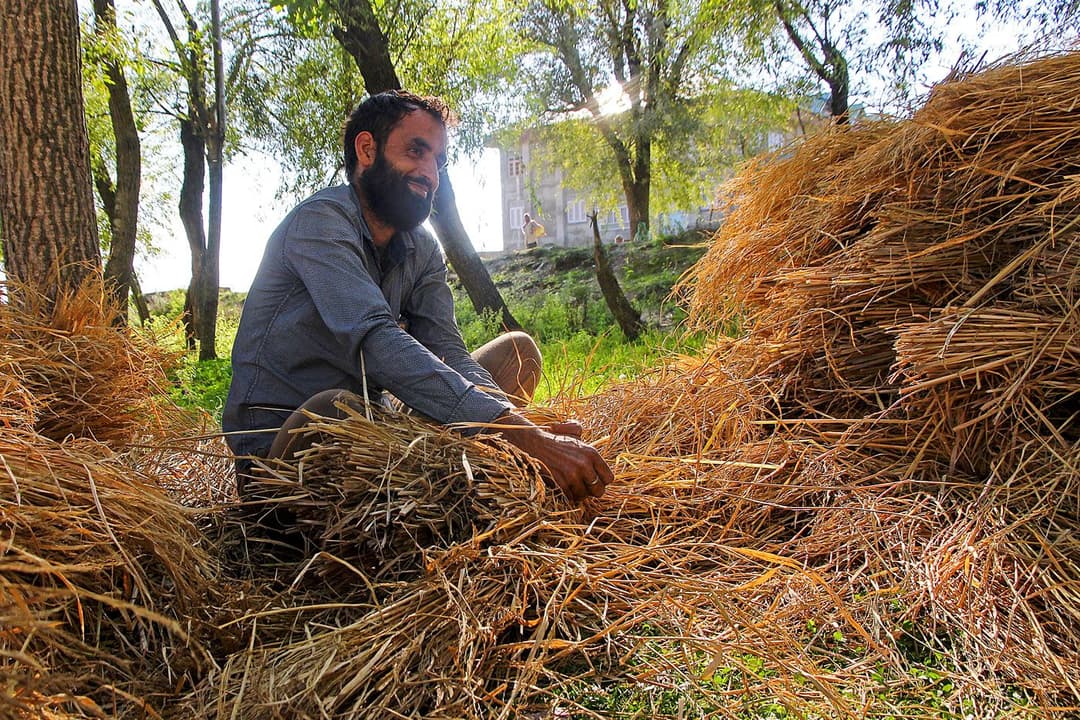
“This might be the last season for cultivating paddy in my fields if Covid-19 does not go away,” said Abdul Rehman, drinking water which Haleema, his wife, had poured for him in a steel tumbler after a tiring day in the family’s field in Nagbal village of Ganderbal district in Central Kashmir.
He was working in the family’s small field – less than an acre – after 10 years. “I stopped working here myself because migrant labourers [mainly from Bihar and Uttar Pradesh] would do more work in less time, which saves me money,” he said. “But now, if ‘outside’ labourers don’t come,” added 62-year-old Rehman, a former government employee, “I might have to give up paddy farming.”
“I am in our field during the harvesting season after some 15 years. We have even forgotten how to harvest paddy,” said 60-year-old Haleema. During the harvest last month, she was bringing food from their house two kilometres away for her husband and son, 29-year-old Ali Mohammad – who, at other times, find jobs as a daily wage labourer at sand extraction and construction sites.
In Central Kashmir’s paddy fields, migrant labourers are usually paid Rs. 1,000 for harvesting one kanal of paddy (8 kanals equal 1 acre), and 4-5 labourers working as a team manage to harvest 4-5 kanals in a day. Local labourers have been asking for higher rates – Rs. 800 per person as daily wages, and four labourers usually harvest 1 kanal a day (rarely 1.5 or 2). That’s a total of Rs. 3,200 per kanal.
The lockdown since March – which came soon after months of shutdown with the abrogation of Article 370 on August 5, 2019, when all non-locals were told to leave Kashmir within 24 hours – has meant hardly any migrant labourers are available for farm work. A few remain and they worked the fields during the paddy sowing season in April-May – but the more strenuous work, say farmers here, is during the harvesting season in August-September.
Around two kilometres from Nagbal, in Darend village, Ishtiaq Ahmad Rather, who owns seven kanals of land and also works as a daily wage labourer, explained, “For one kanal this harvest season a team of four local laborers is charging Rs. 3,200. We cannot afford this. And right now, we can only find daily wage workers who are not experienced in paddy harvesting. But we are helpless, we have to harvest the crop to keep our land ready for next year’s sowing. For the same work, migrant labourers used to charge only Rs. 1,000.”


