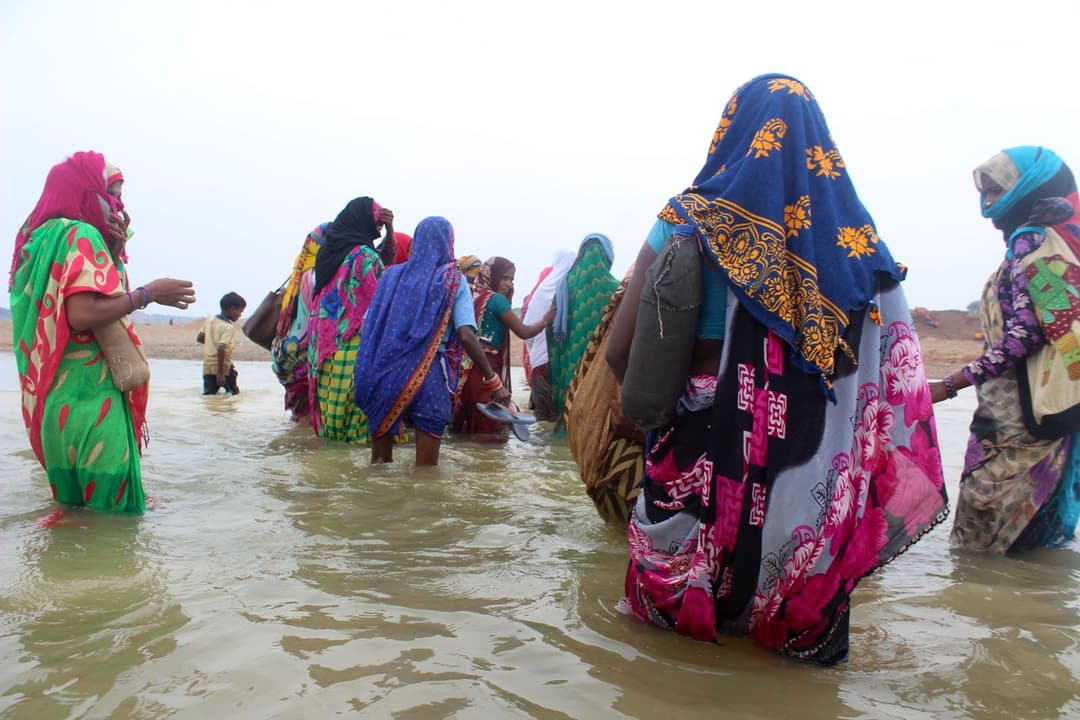


“Fenk debe, khadaan mein gaad debe [We will throw you, bury you in the sand mine].”
That’s what a mining contractor told Mathuriya Devi, a resident of Khaptiha Kalan village. He was furious with her, she says, and some 20 other farmers who had gathered to protest on June 1 against the killing of the Ken – one of Bundelkhand’s major rivers.
That day, the villagers stood for two hours until around noon, in a jal satyagraha in the Ken. The river originates in Jabalpur, Madhya Pradesh, and flows 450 kilometres through MP and Uttar Pradesh – merging with the Yamuna in Chilla village of Banda district. Mathuriya Devi’s village – home to around 2,000 people – is in Tindwari block of this district.
But the stretch of the Ken that passes through a small group of villages here has been shrinking – because a band of locals is quarrying its banks on both sides. This mafia functions, the farmers allege, on behalf of two sand mining companies. The quarrying is illegal, says 63-year-old Mathuriya Devi – who holds a little over 1 bigha or roughly half an acre near the Ken – and it is destroying their farms and livelihoods.
“They have been massively digging on our lands – up to 100 feet deep – using bulldozers,” she says. As she spoke to me by the river on June 2, two young men, not known to her, were shooting her on video. “They have already killed our trees, now they’re killing the river which we once used to draw our water from. We even went to the police, but no one listens to us. We feel threatened….”
The resistance to the quarrying has seen an unlikely alliance of Dalits like Mathuriya and small Thakur farmers like Suman Singh Gautam, a 38-year-old widow with two children. The miners have extracted sand from part of the single acre she owns. “They have even fired in the air to intimidate us,” she says.
The farmers of Khaptiha Kalan village mainly grow wheat, gram, mustard and lentils. “My sarson [mustard] crop was standing in the 15 beeswa land I own, but they dug it all this March,” said Suman.