
This story is part of the PARI series on climate change that won the Ramnath Goenka Award for 2019 in the Environment Reporting category.
“People will call me crazy if I say this,” says 53-year-old Dnyanu Kharat, sitting on the mud floor of his brick house one afternoon. “But 30-40 years ago, during the rains, fish would flood our fields [from the nearby stream]. I caught them with my own hands.”
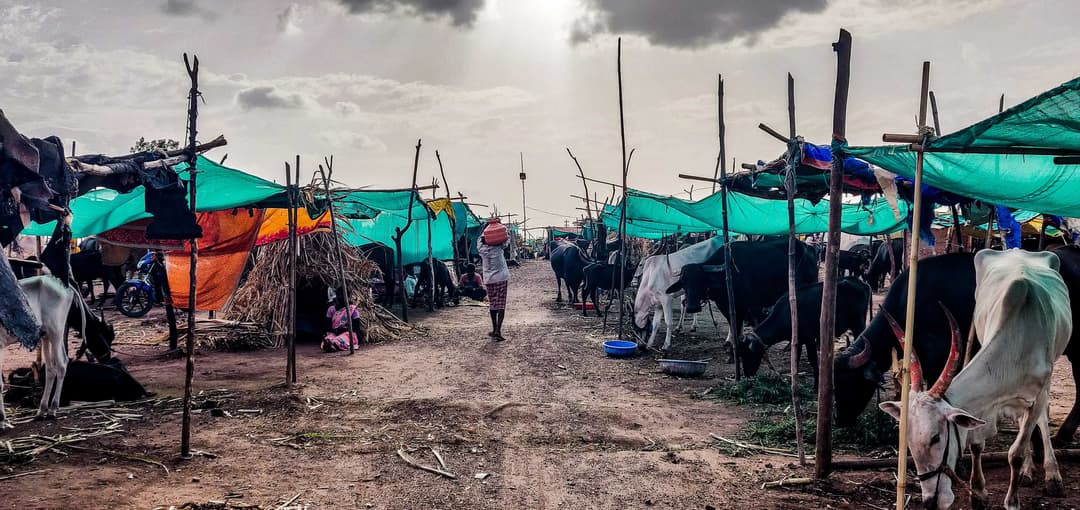
It’s mid-June and just a little while before we reach his house, a 5,000-litre water tanker has trundled into Kharat Wasti hamlet. Kharat, his wife Phulabai, and others in their joint family of 12 persons, are busy storing water in all available vessels, pots, cans and drums. The tanker has come after a week, the shortage of water is acute.
“You won’t believe, 50-60 years ago, we used to get such a heavy downpour, one could not keep the eyes open,” 75-year-old Gangubai Gulig tells us, sitting in the shade of neem trees near her house in Goudwadi, a village of around 3,200 people, some five kilometres from Kharat Wasti in Sangole taluka. “You saw those babool trees on your way here? That entire land produced excellent matki [mothbean]. The murum [basaltic rock] used to hold rainwater and springs would start from our fields. Just four rows of bajra in an acre would yield 4-5 sacks of grain [2-3 quintals]. The soil was that good.”
And Hausabai Aldar, who is in her 80s, remembers the twin wells on her family farm in Aldar Wasti, a hamlet not far from Goudwadi. “Both the wells would be full of water in the rainy season [around 60 years ago]. Each had two mote [a system of bull-drawn pulleys] and all four would run at the same time. Be it any time of the day or night, my father-in-law would draw water and give it to the needy. Now, one can’t even ask for a pot full. Everything has turned upside down.”


