
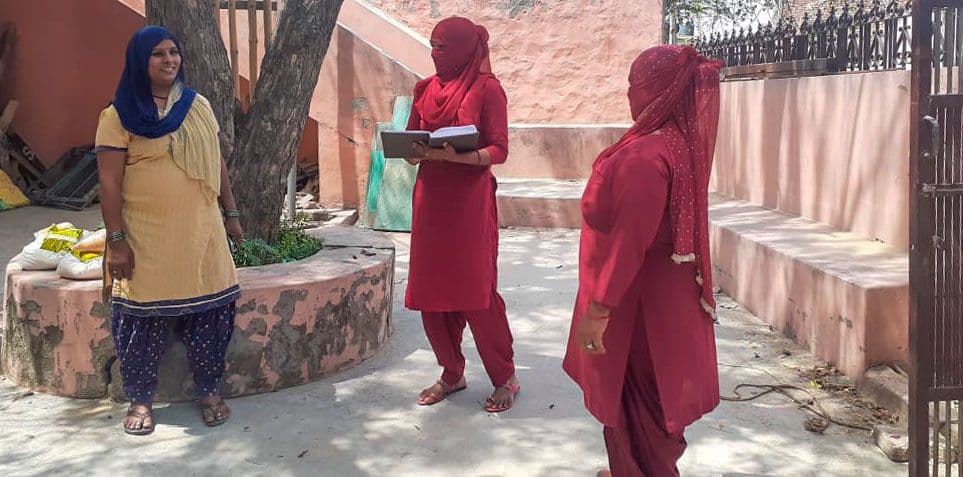
“Now, we must visit at least 25 households every day, each house at least four times in a month,” Sunita Rani says, “to survey for the coronavirus.” She has been making these rounds for over 10 days, while Haryana’s tally of positive cases has been on the rise. That is over 180 confirmed cases and two deaths as of April 14, according to the state’s health department.
“People are scared of this disease. Many think it spreads through touch. They keep saying ‘social distancing’ in the media. Even after I explain what coronavirus is and how they need to stay apart, I don’t know how to look them in the eye,” Sunita says. “What is social distancing in a 10-foot by 10-foot house where seven people live together?”
Sunita, 39, is an Accredited Social Health Activist (ASHA) working in Nathupur village of Haryana’s Sonipat district. One of over 10 lakh ASHAs who connect India’s rural population to its public healthcare system. With Covid-19 becoming the biggest public health and social welfare crisis, her typically busy work day, which could include any of over 60 tasks – from vaccinating newborns to taking care of expecting women, and advising them on family planning – has all turned topsy turvy.
On March 17, when Haryana reported its first Covid-19 case in Gurugram, ASHAs in Sonipat had not yet received any communication from their supervisors about the disease. Four days later, Sonipat saw its first case. There was still no word from their supervisors on new safety protocols, either to follow or to make villagers aware of. By the time Sunita and the 1,270 ASHAs in Sonipat were trained to be at the frontline, creating awareness against the deadly SARS-CoV-2 virus on April 2, the nationwide-lockdown was underway and the state had reported its first Covid-19 fatality.
In charge of roughly 1,000 people in her village, Sunita’s new responsibilities include creating a detailed record of each household within her ambit, the ages of all family members, whether anyone has returned from outside the country and the health status of those at higher-risk of contracting Covid-19 – such as patients with cancer, tuberculosis or heart ailments. “I check and make a note of who has influenza-like symptoms or [those of] coronavirus. All this is not hard. I am used to detailed record-keeping, but the circumstances have completely changed,” Sunita says.

