

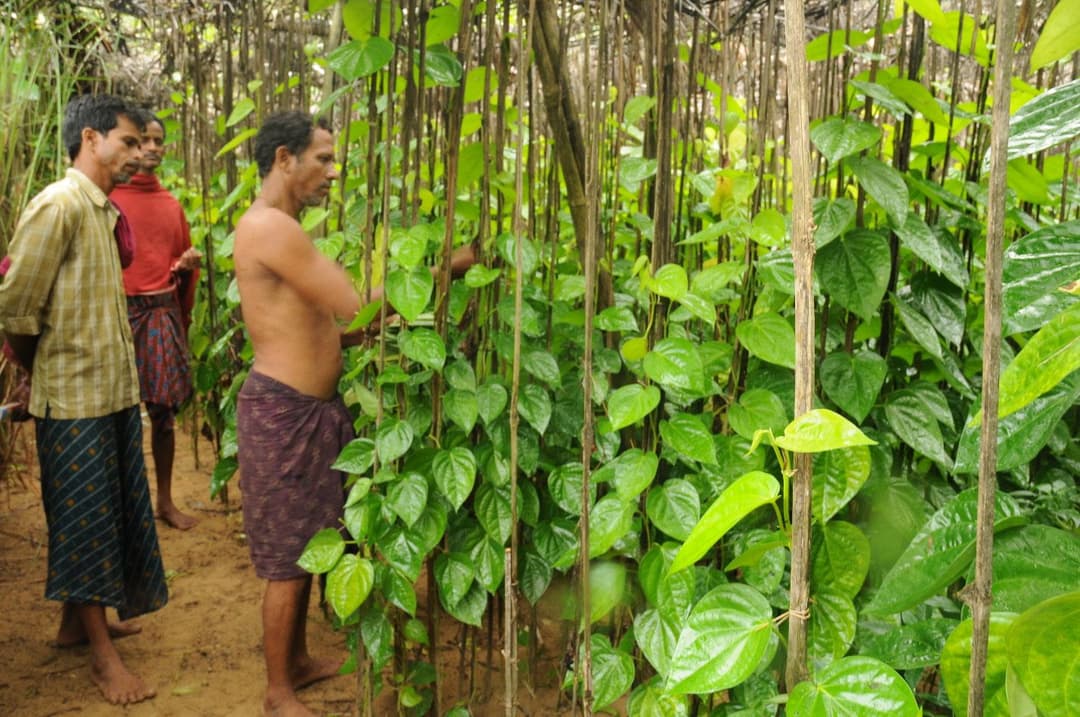
Some of that legendary ‘Banarasi paan' could have begun its journey from Gujjari Mohanty's vineyard in Govindpur, Odisha. “I've sold our leaves in Benares [Varanasi] myself,” says her son Sanatan. As have many of their neighbours. “Our leaves are high-quality and greatly valued.” The betel leaf, though, is not just about pan. It is also valued for medicinal qualities as a digestive, for the antiseptic nature of its oil, and its use along with arecanut for treating different ailments under Ayurveda.
The vineyard is tiny, just a tenth of an acre (roughly 4,300 square feet). Multiple rows of bamboo and other sticks eight feet tall hold up, in all, hundreds of metres of betel vine (Piper betle ). The vineyard is fenced off with bamboo also carrying other creepers. And a thin thatch of casuarina and coconut leaves cover the top. Casuarina leaves offer only a light shade and so make ideal “roofing” — since some degree of sunlight is also vital. The rows are inches apart and you have to walk sideways to cross one. It's expertly organised and feels like a pleasantly air-conditioned room.
“The work is skilled but not strenuous,” says Gujjari Mohanty who, past 70, handles it easily. It requires frequent but light irrigation. “It needs attention every day for brief periods,” says a neighbour. “But even a weak, older person can do much of this.” Some chores, though, are tougher and command twice the daily wage rate of Rs.200. In official count, Posco's project zone holds around 1,800 betel farms. Farmers here say 2,500. These vineyards would die if the farmland here were acquired for Posco's Rs.52,000-crore power and steel project. The government insists the betel farms are on forest land. The villagers, who have occupied this land for well over 80 years, demand their rights over it be recognised under the Forest Rights Act of 2006.

