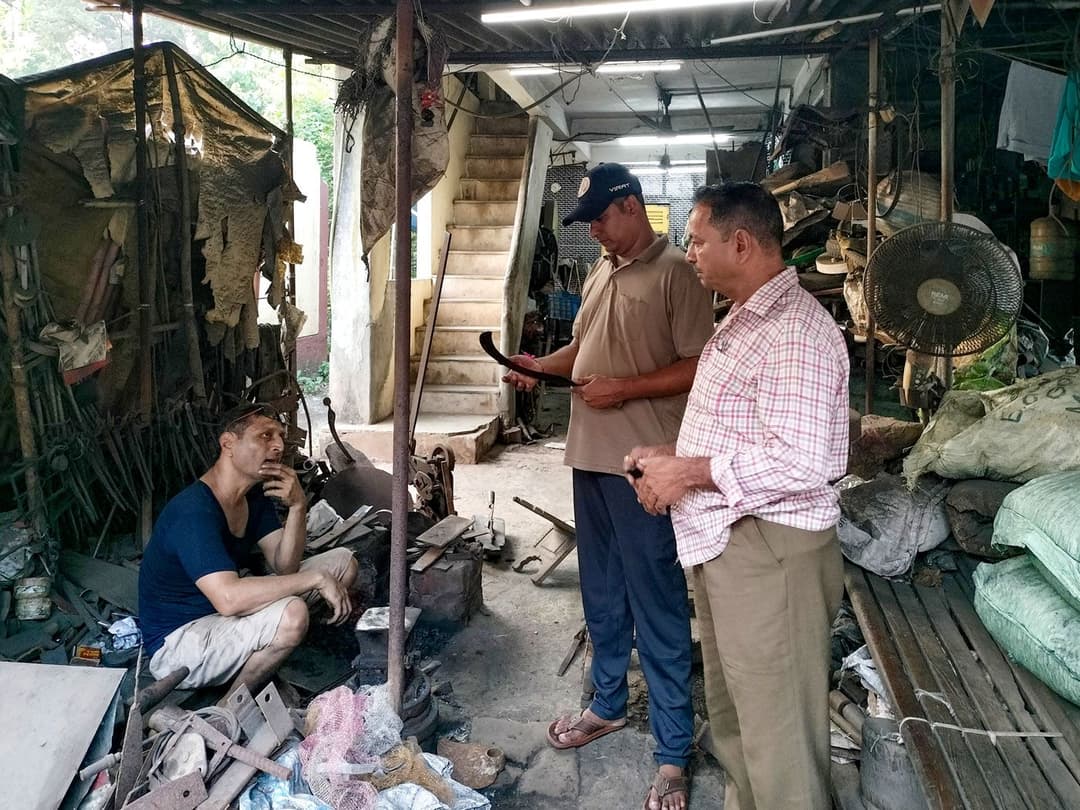
“One small mistake and you will get a sattur instead of koyta!” Rajesh Chaphekar would know the difference between a butcher’s knife and a sickle. A master lohar (blacksmith), he has crafted more than 10,000 iron tools at his workshop in Actan village in Maharashtra.
The 52-year-old learnt from his father, Dattatrey Chaphekar, and belongs to a long line of panchal lohars who have enjoyed the loyalty of their customers from among the farming community in Maharashtra. “People would say, ‘Actan se hi hatyar leke aao’ [Get the tools only from Actan],” says this seventh generation blacksmith in Vasai taluka. He can make more than 25 different farm tools.
Customers came from as far as Uran in Navi Mumbai – roughly 90 kilometres away, to place bulk orders for tassni, a tool that was crucial in the making of boats. “Girhaiks [customers] would stay at our house for four days and observe us making the tool from scratch,” he recalls.
The narrow lanes in Actan village have been traditionally demarcated on caste-based occupations: sonar (goldsmith), lohar (blacksmith), sutar (carpenter), chambhar (cobbler) and kumbhar (potter). People in the village say they have always been disciples of Vishwakarma, a popular deity of craftspeople. Panchal lohars are listed under Nomadic Tribes since 2008, before which they were classified as OBC (Other Backward Classes).
Rajesh says he had no intention of continuing his family's blacksmithing tradition when he turned 19. His job as a storekeeper in an electronics shop where he was working, fetched him Rs. 1,200 a month. It was a few years later that a fallout in the larger joint family left his father without work, forcing him –the eldest son –to join the family trade.