

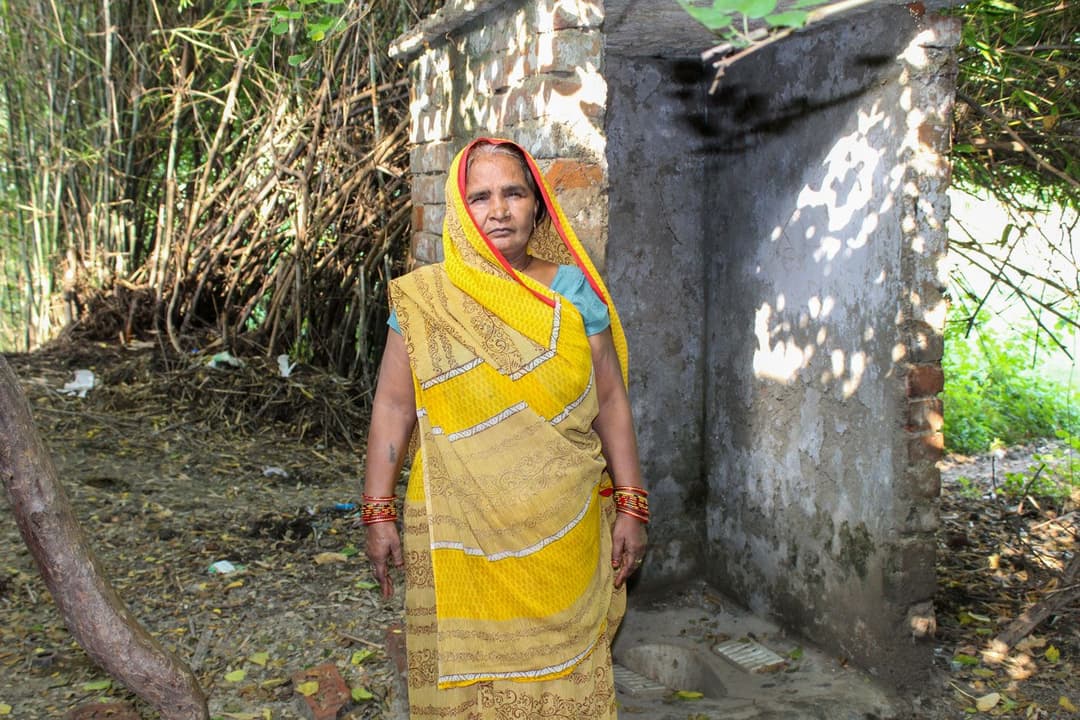
It takes 60 steps for Vitto Pandey to reach the toilet. She cannot make that journey alone over uneven land. Sometimes, she waits for hours for someone to hold her hand and walk with her. “I keep falling. I fall and I get up. Once, I was hit by a bull and for weeks my body was swollen,” she says.
Vitto, who is visually impaired since birth, is usually taken to the toilet by her brother’s wife, Geeta. “Sometimes I am in the middle of other work when she calls out. It is a problem,” says Geeta, who herself uses the fields. “There is no running water in the toilet, so it gets very dirty. It is a useless toilet,” she says. Her husband Sanatak is the youngest of Vitto’s three brothers. He farms on their one bigha (around 0.6 acres) land in their village, Bakhari, in Lucknow district’s Gosaiganj block.
Many of the 203 toilets in Bakhari, of which most are located far from the living quarters, are crumbling and in no shape to be used. The lack of access to even a rudimentary toilet has meant prolonged stretches of self-control, long walks, and frequent humiliation for the village residents.
Tarawati Sahu, a homemaker, remembers countless times when she had an upset stomach, and defecated in front of someone’s house while hurrying to the fields. “It is very shameful. The neighbours give us dirty looks. When my stomach is upset and I can’t control myself, I sometimes wash the streets where I defecate, five times a day,” she says. At 65, the five-minute trek to the fields is a difficult journey for her. Her 72-year-old husband Mata Prasad Sahu, who is too ill to work in their three bighas of farmland, faces similar problems. “We have folded our hands before so many, but no one has paid attention to us. I am tired of asking for a toilet,” she says.


