

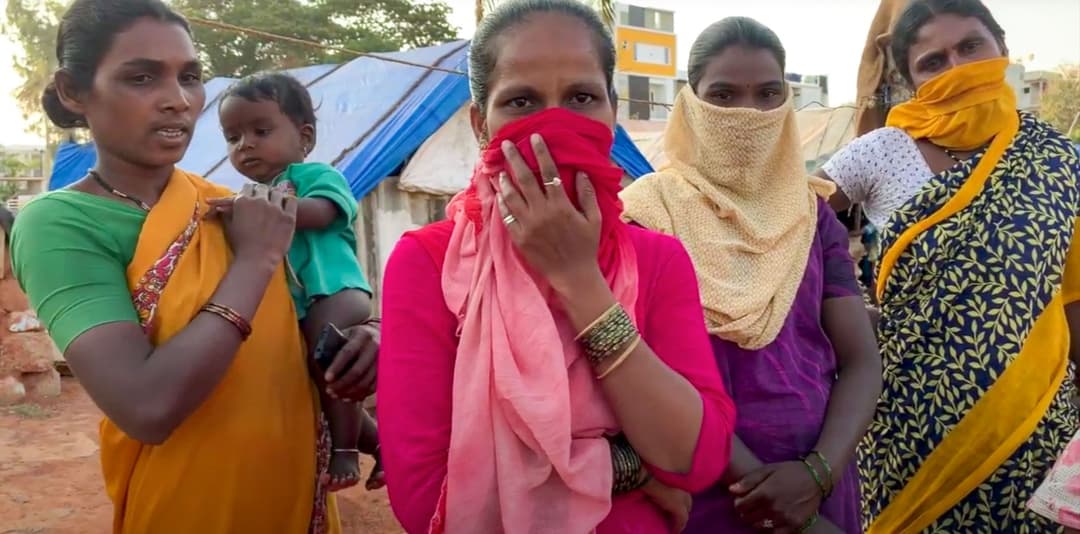
Maktumbe M.D., who lives in a slum colony in Rachenahalli, has been anxious about how she will feed her family during the Covid-19 lockdown. “My husband used to get paid once a week. That’s when we would go buy food. For the last two weeks, nobody’s been paid and we haven’t bought rations,” said Maktumbe, a 37-year-old homemaker, when we met 10 days after Bengaluru city shut down. Her husband is a commercial painter; he usually earned around 3,500 per week, but hasn’t found work since the lockdown began on March 25.
The couple, who have three children, migrated to Bengaluru 10 years ago looking for work. They came from Talikota (locally also called Talikoti) town in Karnataka’s Vijayapura (formerly Bijapur) district. The family depends on the payment that Maktumbe’s husband, Moulasab Dodamani, received every Sunday. “We bought food items once a week – five kilos of rice, one kilo oil, dal, and so on – and manage our lives. That’s stopped now. We are not allowed to go anywhere. We want to step out for food.”
When we met on April 4, the residents of the colony of migrant daily-wage workers in north Bengaluru spoke about various hardships. None of them are eligible to receive the government-subsidised foodgrains promised under the union finance minister’s relief package. Many don’t possess a ration card. Some do, but it is registered on their home address in their village, explained Manikyamma, 30, originally from Raichur district in north Karnataka. “Those cards don’t work in Bengaluru,” she said.
“We are struggling now without work. There is a lot of difficulty. We have children, we have to pay rent, how are we supposed to do that?” she asked. Manikyamma and her husband Hemanth worked as construction labourers before the lockdown; they came to Bengaluru about seven years ago, and have four children.
Lakshmi N., 27, also from Raichur, came to the city around the same time as Manikyamma. She was working on construction sites in north Bengaluru till the lockdown began. “We make cement and break stones. We earn 300 rupees a day for this work,” she told me. She pays Rs. 500 per month for the single-room makeshift shed in Rachenahalli, where she lives alone.