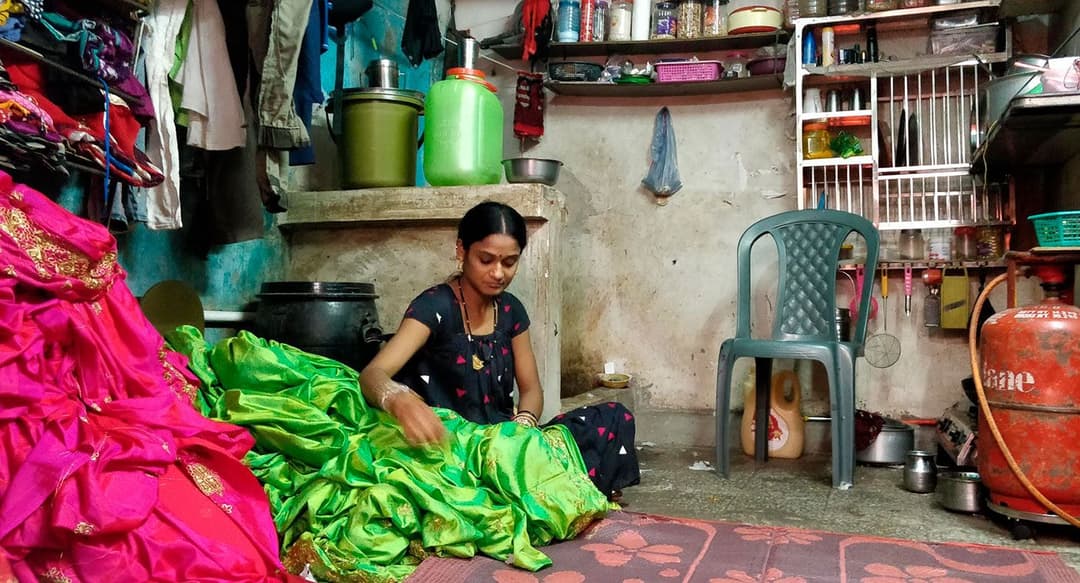

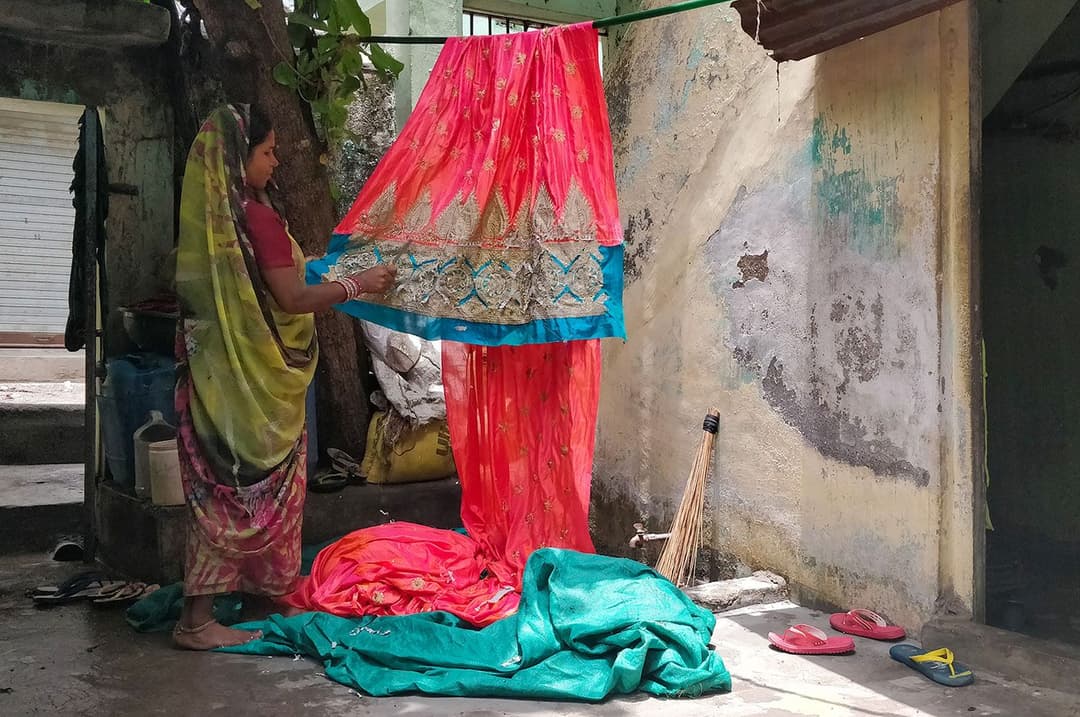
Every day at 10 a.m., Renuka Pradhan’s one-room home in the Mina Nagar area of north Surat turns into her working space. Bundles of colourful sarees, delivered at her doorstep, are placed near the kitchen sink, the doorway, and even pushed under the khatiya. Pradhan swiftly unpacks a bundle to pick out a bright pink-and-blue polyester saree that she hangs over a water pipe outside her room.
The saree has been brought here from the fabric-manufacturing units located on the neighbouring Ved Road. During the mechanised embroidery process, the machine work leaves behind loose threads at the back end of the polyester fabric. These have to be carefully pulled out before the fabric can be sent back to the ironing and folding department in the textile units. This is where home workers like Pradhan step in.
Using her index finger and thumb, Pradhan pulls the extra threads hanging out of more than 75 sarees in a day. If the saree is made of the relatively more expensive polyester silk, she uses a knife to cut the loose threads. “I spend around five to seven minutes on each saree,” she says. “In case I pull too much thread and end up damaging the fabric, I will have to reimburse the entire cost of the saree to the contractor. I have to be very careful.”
At the rate of Rs. 2 per saree, Pradhan earns up to Rs. 150 every day. An error is likely to cost her nearly five days of her wages. “By the end of the [eight-hour] day, I can barely feel any sensation in my fingers,” she says.