

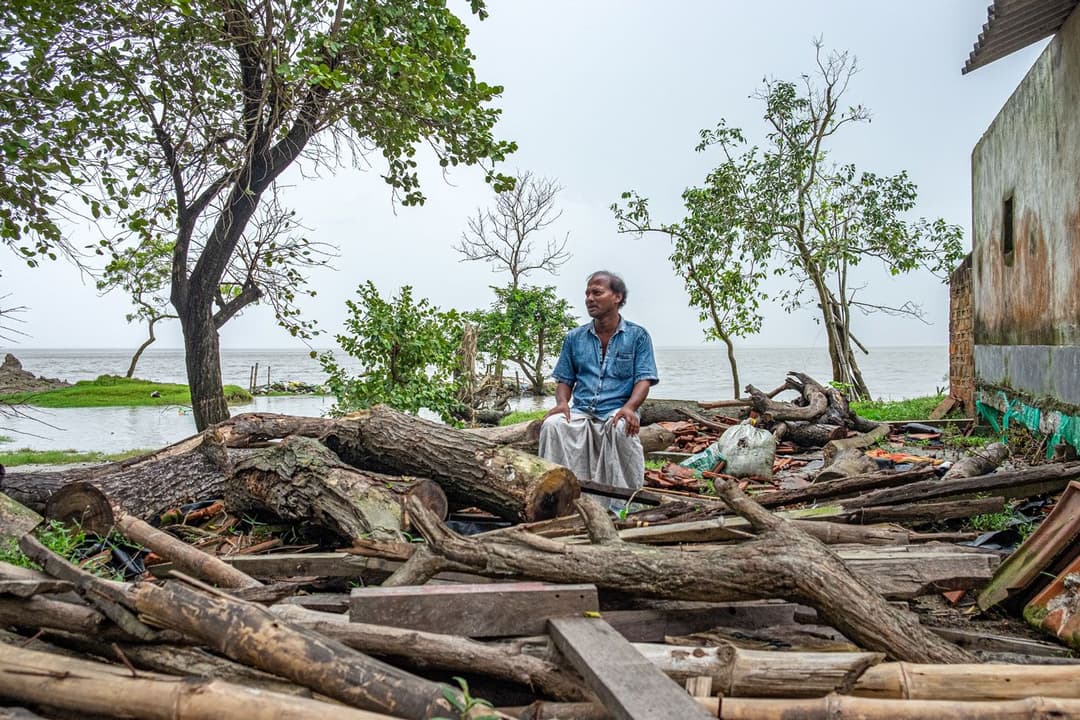
A burst of activity rises in the ferry docking at Ghoramara island in early September. Men, women, children, and cattle too, hurry to get off the boat and go about the day’s business. Having taken shelter elsewhere during the high tide, often with relatives, they are returning home to the island after the waters had receded. The ferry, which takes 40 minutes from mainland Kakdwip to reach the island in the Sundarbans delta, carries such passengers to and fro at least twice a month. However, this routine belies the long struggle of Ghoramara's villagers to survive on their small island located in West Bengal’s South 24 Parganas district.
Frequent cyclones, rising sea levels and heavy rains – markers of climate change – have made life difficult for Ghoramara’s people. Floods and soil erosion over the decades have turned their isolated homeland into a floating piece of land in the Hooghly estuary.
When Cyclone Yaas made landfall in May, Ghoramara, in Sagar block, was among the worst hit areas in the Sundarbans. On May 26, the cyclone along with high tide had breached the island’s embankments and inundated it within 15-20 minutes. The islanders, who had borne the impact of cyclones Amphan (2020) and Bulbul (2019) earlier, faced destruction again. Their homes were ripped out, and entire storehouses of paddy, betel crops and sunflower fields were washed away.
Abdul Rauf’s house near Khasimara ghat was destroyed in the cyclone's aftermath. “We had no food for those three days and survived on rainwater, and were protected by just plastic sheets,” said Rauf, a tailor who works in Kolkata, about 90 kilometres away. When he and his wife fell ill, “everyone suspected that we had Covid,” he said. “Many had fled the village,” added Rauf. “We lay there, unable to escape to safety.” It was when the block development officer was informed that Rauf and his wife received medical attention. “The BDO asked us to reach Kakdwip by any means possible. He made arrangements for an ambulance from there. We had to spend about 22,000 rupees [on medical care].” Rauf and his family have been living in a shelter on the island ever since.
Many whose homes were destroyed were moved to temporary shelters. Residents of Mandirtala village are housed at a shelter in Tank Ground near Mandirtala bajar (bazaar), the island's highest point. Some of them set up camp on a narrow road nearby. From Hatkhola, Chunpuri and Khasimara areas of the island, 30 families were temporarily sheltered on Sagar island, to the south of Ghoramara. They have since been allotted land there, to relocate.


