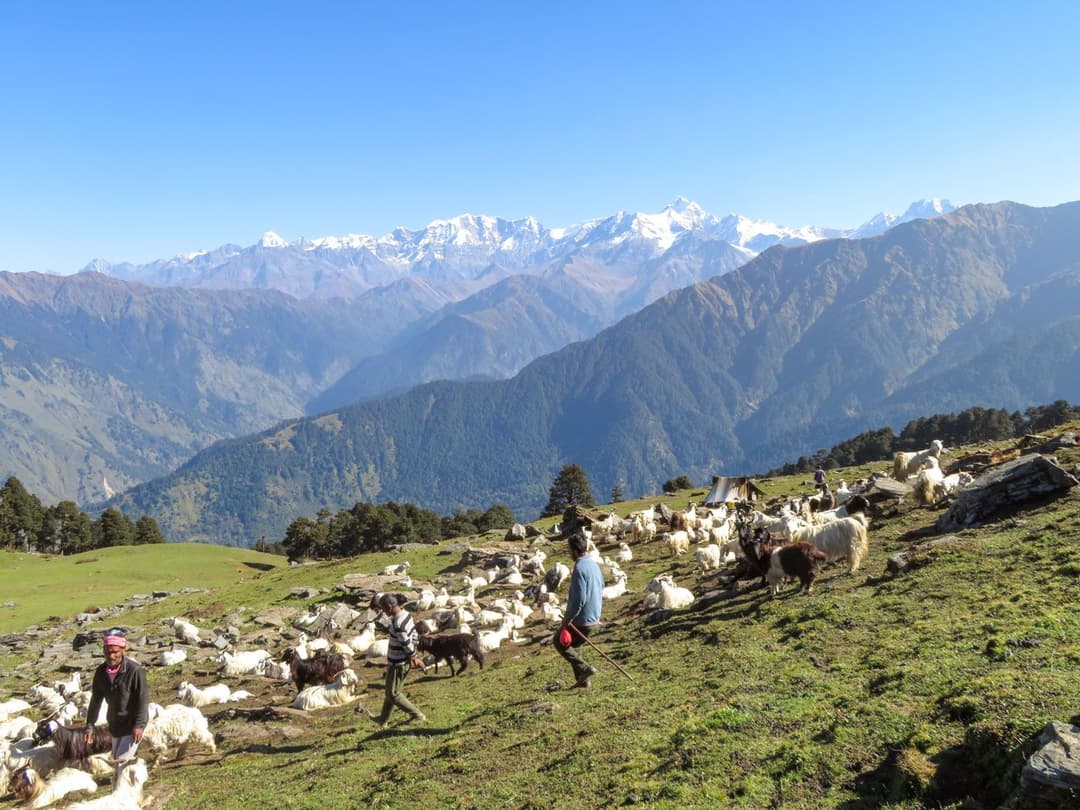
“In a year we lose many animals to leopards. They come at night and snatch them away,” says shepherd Gaur Singh Thakur. Even the native Bhutia dog, Sheroo, cannot keep them away, he adds.
He is speaking to us high up on a mountain in the Gangotri range of the Himalayas. The animals he herds belong to seven families who live in and around Saura village of Uttarkashi district. Gaur Singh belongs to the same village that lies 2,000 metres below. He is under contract to look after the animals for up to nine months a year. Rain or snow, he must be out and about, herding, gathering and counting the animals.
“There are roughly 400 sheep and 100 goats here,” says the other shepherd, Hardev Singh Thakur, 48, looking at the herd scattered on the mountain. “There could be more,” he adds, a little uncertain of the exact number. Hardev has been doing this work for the last 15 years. “Some shepherds and helpers come for two weeks and go back, some like me stay on,” he explains.
It’s October, and a bitterly cold wind is whipping the grass up here on ‘Chuli top’, a meadow on the Gangotri range of the Garhwal Himalayas in Uttarakhand. The men have a blanket wrapped around as they move amongst the jostling animals. This is a good meadow, the shepherds say, the thin stream originating in a snow bank higher up is an assured source of water for the animals. It snakes through stony crevices as it descends, emptying more than 2,000 metres below into the rushing Bhilangana river, a tributary of Bhagirathi.