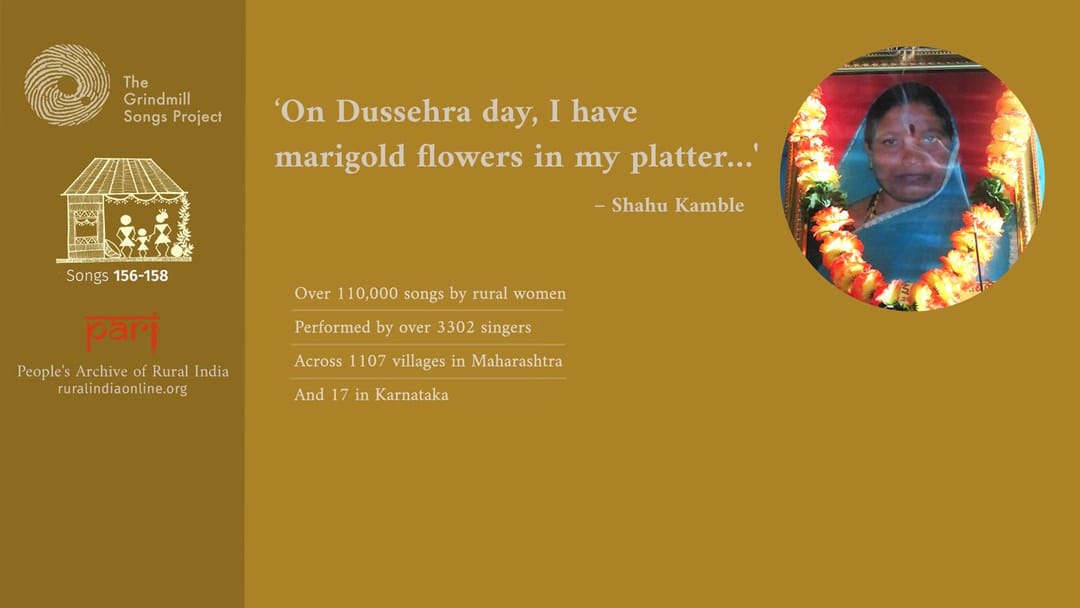
Kusumtai Sonawane, whose ovi were featured on PARI in Burn, burn, youth, because a young woman is blamed on March 15, 2017, also lives in Nandgaon. She says, “Shahu and I were friends from childhood, we went to school together in Kolwan village though we studied only till the first standard.” The two were also related – Shahubai’s husband is Kusumtai’s first cousin. As friends and like sisters, they spent time with each other. They practiced different tunes and thought of new ones while pounding grain in the mortar with a wooden pestle. These tunes would then be put to use while singing ovi while they worked at the grindmill to make flour from grain. “‘Each of us would bring a kilo of rice or gram to grind and sit together singing the grindmill songs,” says Kusumtai.
Shahubai sang 401 songs for the grindmill songs database, of which around 170 were audio recorded in October 1999. These are a part of the database of over 110,000 ovi from rural Maharashtra. The project is now hosted on PARI, and a PARI team has been revisiting several villages to meet the singers, take photographs and record videos.
This edition contains three ovi about Dussehra. The festival marks the end of the nine days of Navratri – the tenth day, that celebrates the victory of good over evil, when Goddess Durga triumphs over the demon Mahishasur. In the Mahabharata, it is said that the Pandavas completed their year-long exile on this day. In the Ramayana, it was on this day that Ravana was killed by Lord Rama.
During this and a few other Hindu festivals, women in households that follow traditional customs, felicitate the men in the family through a simple ritual. The woman carries a platter with flowers, kunku (the Marathi word for red vermillion powder) and an oil lamp with a lit cotton wick. While the man sits in a chair or on a low wooden platform on the floor, she applies the kunku on his forehead and rotates the platter with the lamp clockwise a few times, reflecting its light on his face. This ritual is called ovaalne in Marathi. There are also some festive occasions when children or women are felicitated in this way. The word vavāḷū (ovāḷū) in the three couplets refers to this ritual.