

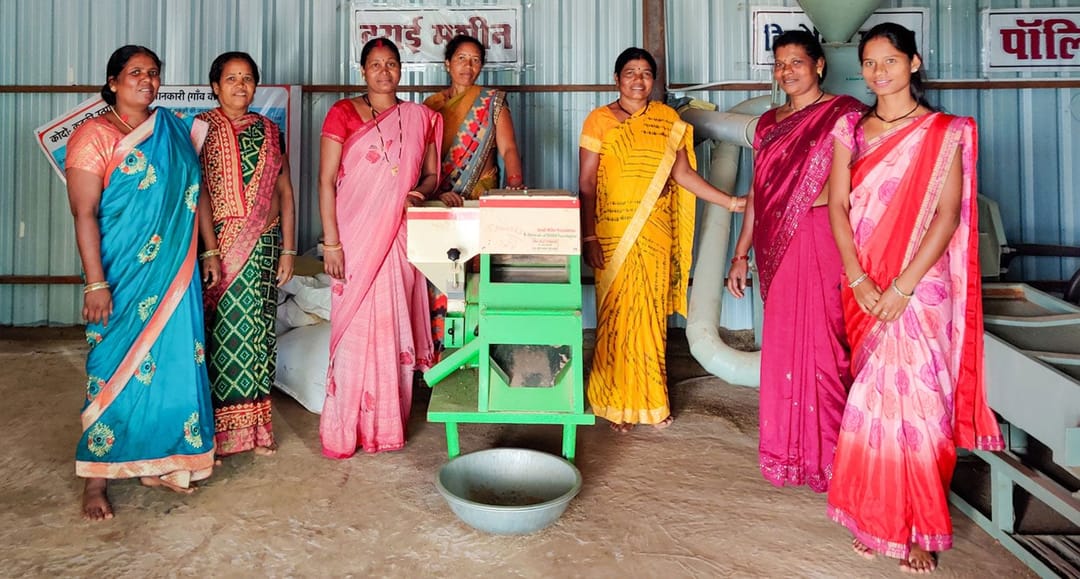
“Some years ago, if we wanted to bring up issues in the gram sabha [village council] about building a pond in the village or something else, there was no place for us women to sit and talk to the sarpanch or the adhyaksh [president] of the village council,” says Godawari Maravi.
Things have changed to a great extent since then but not without the grit and persistence of the women PARI met in Bargagaon, Madhya Pradesh on a rainy day in July 2024.
Godawari and six other members of the all-female Halchalit Mahila Kisan Women Producer Company Limited (HMKWPC) had arrived in the morning. They were seated in the large shed-like office cum warehouse, with a tin roof and walls, located in Samnapur block of Dindori district. A chair and table with a computer, a few shelves and an air-cooler define the small office on one side of the entrance.
The name of the producer company originated through the women’s pride in identifying themselves as farmers. Since working with a hal or plough is traditionally considered a man’s job, they challenged this belief to refer to themselves as women who use the plough – hal chalit. And so the name – Halchalit Mahila Kisan Women Producer Company. Today they have 1,400 registered members who are also shareholders.
Two of its members, Godawari Maravi, 44 and Devaki Wagle, 47, live in Bargagaon (also called Barga village) and have walked to the office. The other women have travelled from their homes in Samnapur block by autorickshaws, or rode pillion on a motorcycle with a family member.
Godawari Maravi is now the Chairperson. She begins by telling us how traditionally, farmers here did not use chemical inputs, but that gradually changed from 2010 when use of chemical fertilisers and pesticides in agriculture became the norm. Since 2022 however, many farmers in Dindori district are trying to move to organic or natural farming, or a combination of both. They are supported and encouraged by organisations working to promote non-chemical agriculture.
“We give organic seeds to the farmers. When the field is ploughed along with grass, weeds and harpatwar [stubble], these get mulched in the soil and are the first natural fertiliser,” Godawari tells us.


