

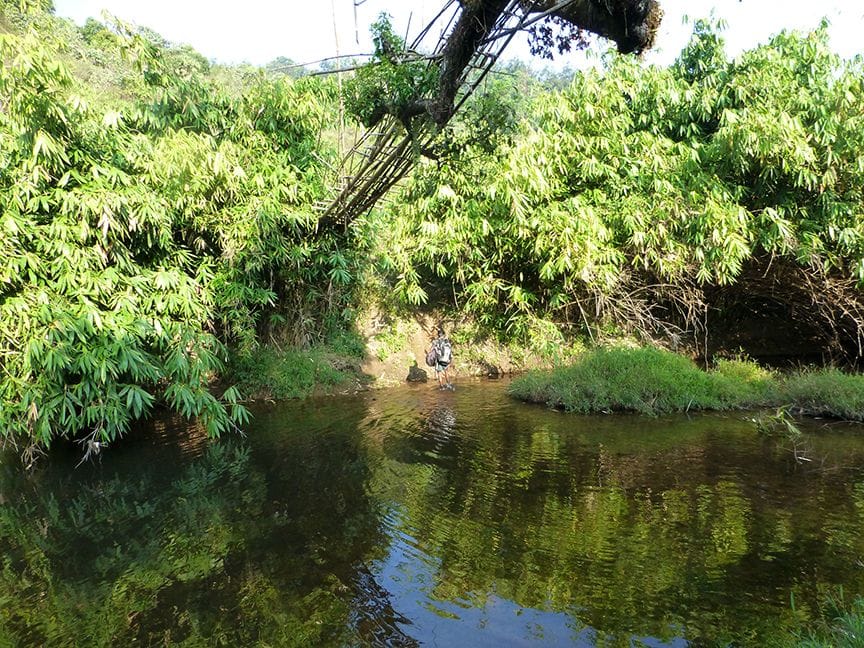
We had spent nearly an hour in the field with its tall grasses and many trees. In the company of a wild bull elephant we could not see. That is, our band of eight wanderers visiting Kerala’s remotest panchayat , Edamalakudi, could see nothing. Everybody else seemed to follow his movements clearly. We could hear the shouts of aanai (elephant) from villagers not visible to us. Raised voices whose owners were in nearby hamlets advised one and all not to go near the water. Adivasis crossing us on their way to Societykudi — from where we had just come – told us: "He’s down by the river. Watch out."
This was not comforting, since we were trying to cross the river Manalar at that very moment. It had this 'living bridge' made of bamboos, tree branches, creepers, ropes and stray pieces of wood. But it was in disrepair and usable only in the monsoon. We retreated to the nearby field. The voices continued. Our ‘forest watcher’ Achuthan M., himself a Muthavan Adivasi, seemed clear about the pachyderm’s whereabouts. And maybe those in the distance were using the tree-top machans that we’d passed the previous day. Perhaps that was how they kept track of him. A lone bull elephant is bad news. The chances are he was in masth and had been expelled by an annoyed herd.
This is the moment you remember all the worst elephant stories. Or recall that a bull in masth can have testosterone levels 60 times higher than he normally would – and is likely spoiling for a fight. With no one of us inclined to oblige him (our testosterone levels weren’t up to it), we retreated under the shade of a tree. Each time something moved between the trees, we wondered: is that a ‘forest watcher?’ Or the bull? For that hour, the beauty of Idukki’s forested wilderness was lost on us.
Lesson learned: never trust a ‘short-cut’ in unknown terrain. It invites disaster.

