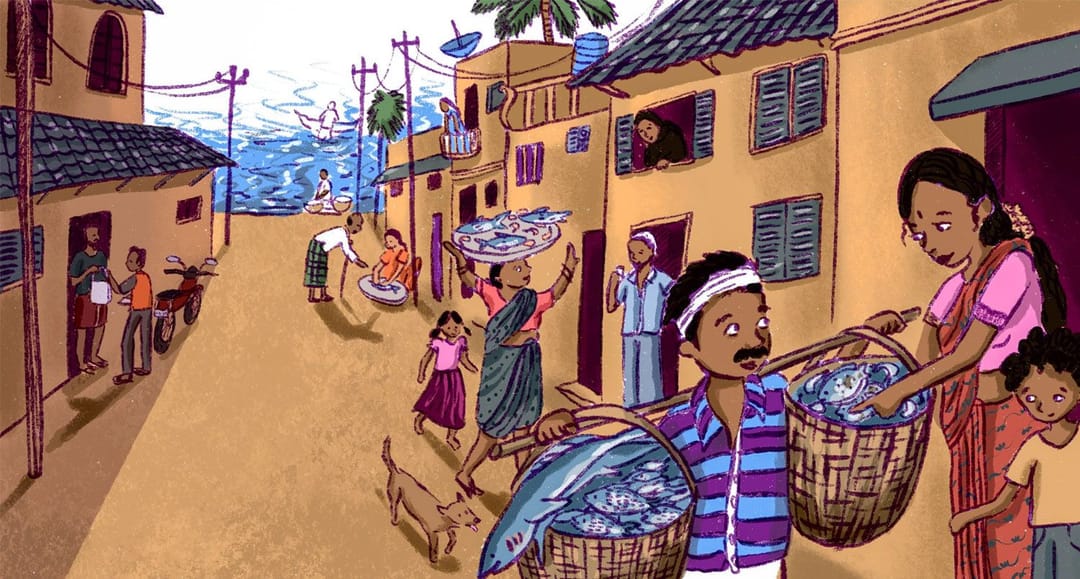
About an hour from our village Barri Phulwaria, in Bihar’s Sitamarhi district, is Bhawanipur. A woman from there used to roam around the mohallas in our village with meat stacked up in a chhyanti, bamboo-basket, on her head. She was quite fond of paan (betel leaf), so everybody called her Paanwali. This was 1979.
Those were the days of severe scarcity, very few could afford fish or meat. But when Paanwali came, once in a couple of months, it was like Eid for us. Gos le lo gos (Come buy meat, come buy meat)!
As a child I was so fond of meat that my grandfather, Sheikh Abdul Hakim, used to tease me by saying, “Jab bada hoga, teri shadi Paanwali ki beti se kara dunga [you grow up, I will get you married off to Paanwali’s daughter].
Ours was a Muslim majority village. There were only two roads from Bhawanipur to Phulwaria. One ran through Narharpur, and the other was via Basaul. Both of which had a mixed population of Hindus and Muslims. And then there was river Adhwara that Paanwali had to cross to reach our village.
From our village she used to walk through Barri and Bajitpur, villages with Hindu majorities, to reach Kanchanpur, where she sold the leftover meat.
Today it would seem unbelievable, but no one stopped this woman from going door to door with a basket-load of meat on her head, no one harmed her as she walked through the villages. Muslims were not upset with the Hindus in our areas eating pork, consuming toddy and alcohol. And similarly, Hindus were not troubled by Muslims enjoying meat.
Today, I don't know whether Paanwali is alive or not, but surely that time isn’t. The distance between Bhawanipur and Fulwaria just keeps increasing.