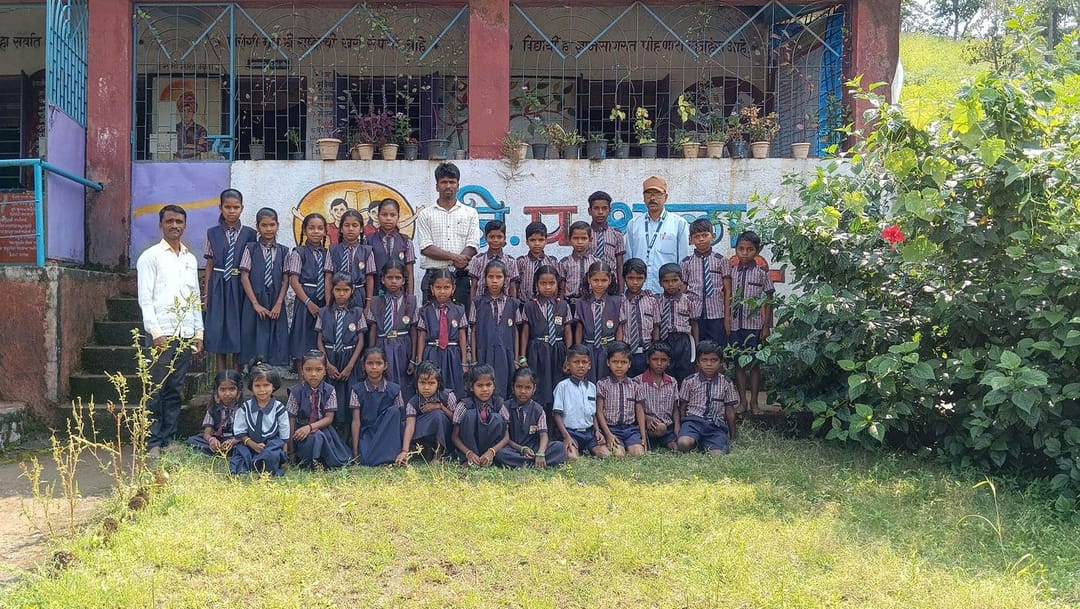
Until around the 1990s, there was hardly anyone in this area who had studied beyond Class 10. The new generation has slowly begun to pursue formal education. If there are, say, 25 Warli students enrolled in Class 1, only about eight students make it to Class 10. The dropout rate is very high. Out of those eight, only 5-6 pass the exams. Even more students drop out by the time they reach Class 12 so finally only 3-4 students finish school.
Pursuing an undergraduate degree is possible at the taluka level – a journey of roughly 10 kilometres. But there is nothing more in the area and students travel to places like Thane, Nashik or Palghar city for further education. As a result, only about three per cent of the people in this taluka have an undergraduate degree.
In the Warli community, the rate of education is particularly low, and efforts are on to improve it. We are also making greater efforts by visiting villages and communicating with the people in their own language, both to establish a connection and build trust.
PARI would like to thank Hemant Shingade from AROEHAN for his help with this documentation.
Interview: Medha Kale
This story is part of PARI's Endangered Languages Project which aims to document vulnerable and endangered languages of the country.
Warli is an Indo-aryan language spoken by the Warli or Varli Adivasis in India residing in Gujarat, Daman & Diu, Dadra & Nagar Haveli, Maharashtra, Karnataka and Goa. UNESCO's Atlas of languages has listed Varli as one of the potentially vulnerable languages in India. We aim to document the Warli language as spoken in Maharashtra.