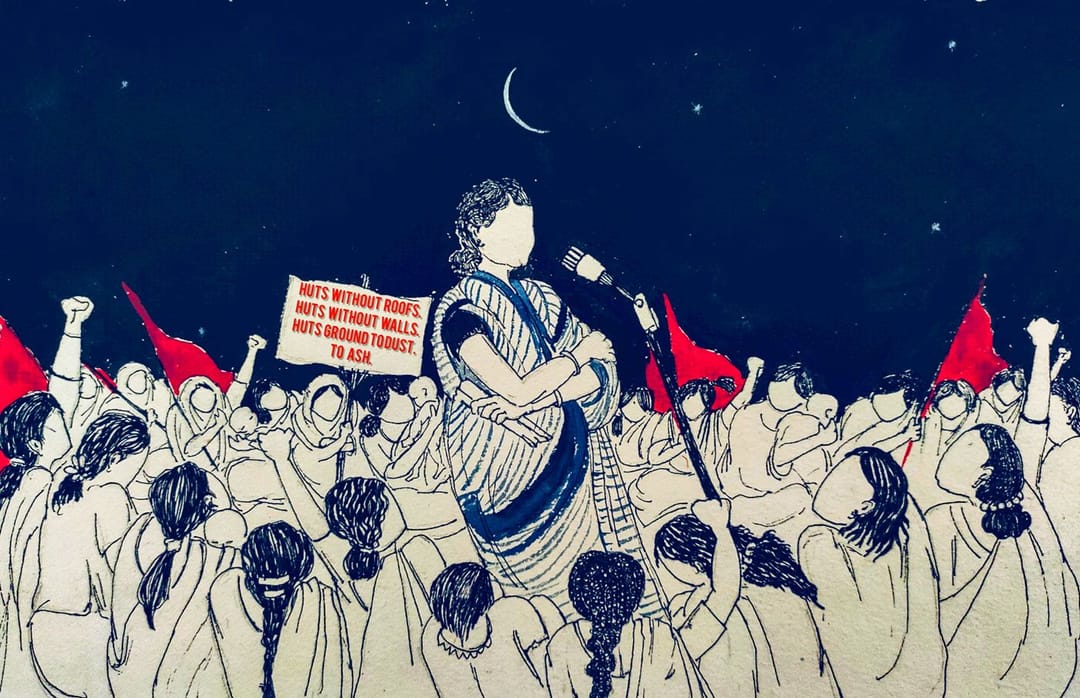
In the last week of December 1968 the long simmering struggle of organised labour against oppressive landlords in Keezhvenmani hamlet of Venmani village, boiled over. Dalit landless labourers of this village in Tamil Nadu’s Nagapattinam district were on strike, demanding higher wages, control over agricultural lands, and an end to feudal oppression. The landlords’ response? They burnt alive 44 Dalit labourers in the hamlet. The rich and powerful landowners, riled by a new political awakening among the Scheduled Castes, decided to not only hire other workers from neighbouring villages, but also planned a massive retaliation.
On the night of December 25, the landlords surrounded and attacked the hamlet, cutting off all routes of escape. A group of 44 workers who had rushed into a hut were locked inside – before their attackers set it on fire. Fully half of those murdered – 11 girls and 11 boys – were children below the age of 16. Two were over 70 years of age. In all, 29 were female and 15 were male. All were Dalits and supporters of the Communist Party of India (Marxist).
In 1975, the Madras High Court acquitted all the 25 accused in the murder case. But Mythili Sivaraman, one of the great chroniclers of this incredible atrocity, continued to write powerful and extensive analyses that not only brought the massacre to light but also its underlying issues of class and caste oppression. We publish this poem on that tragedy in a week that has seen the demise of Mythili Sivaraman of Covid-19, at age 81.
Forty-four stone fists
Huts without roofs.
Huts without walls.
Huts ground to dust.
To ash.
44 stone fists
line the cheri,
like an angry memory,
like a war cry from history,
like tears gone cold and fiery,
witnesses to the wretched night of
December 25, 1968
when Christmas was certainly not merry.
Listen to the story of the 44;
hear one, hear all.
Huts without roofs.
Huts without walls.
Huts ground to dust.
To ash.
Flashback to four measures of paddy.
Four is not enough, not enough they said,
not enough to feed the landless and hungry.
Hungry for food, hungry for land.
Hungry for seeds, hungry for roots,
Hungry to claim their broken backs,
their toil, their sweat, their labour’s fruit.
Hungry for their upper caste neighbours,
the landlords, to see the truth.
Huts without roofs.
Huts without walls.
Huts ground to dust.
To ash.
Some of them were clad in red
with a sickle and a hammer
and ideas in their head.
All were poor and all were mad
Dalit men and women,
defiant children of labourers they were.
We unionise, all of us, they said,
let us not harvest the master’s fields.
Little they knew as they sang their blues
whose was the harvest, who was to reap.
Huts without roofs.
Huts without walls.
Huts ground to dust.
To ash.
The masters were always sharper,
calculating and merciless.
They hired help from neighbouring villages
“Beg forgiveness,”they said.
“For what?” retorted the labourers.
So the landlords locked them –
scared men, women, children,
44 in all, huddled in a hut.
Shot them, torched them.
Trapped inside,
they burst into flames
in the middle of the night.
22 children, 18 women, and 4 men
made the tally
of those slain brutally
in the massacre of Keezhvenmani.
They live in newspaper clippings,
in novels and research journals
Huts without roofs.
Huts without walls.
Huts ground to dust.
To ash.
Author's note: I wrote this poem after being deeply moved and inspired by Meena Kandasamy's novel The Gypsy Goddess on the Keezhvenmani massacre of 1968.
* cheri: Traditionally, villages in Tamil Nadu are segregated into oors, where the dominant castes live, and cheris, where Dalits reside
* The refrain used in the poem – Huts without roofs/ Huts without walls/ Huts ground to dust/ To ash – is from the opening lines of an essay about the 1968 massacre written by Mythily Sivaraman titled Gentlemen Killers of Kilvenmani, published in the Economic and Political Weekly, May 26, 1973, Vol. 8, No. 23, PP. 926-928.
* These lines are also in Mythily Sivaraman’s book Haunted by Fire: Essays on Caste, Class, Exploitation and Emancipation, LeftWord Books, 2016.
Audio: Sudhanva Deshpande is an actor and director with Jana Natya Manch, and an editor with LeftWord Books.