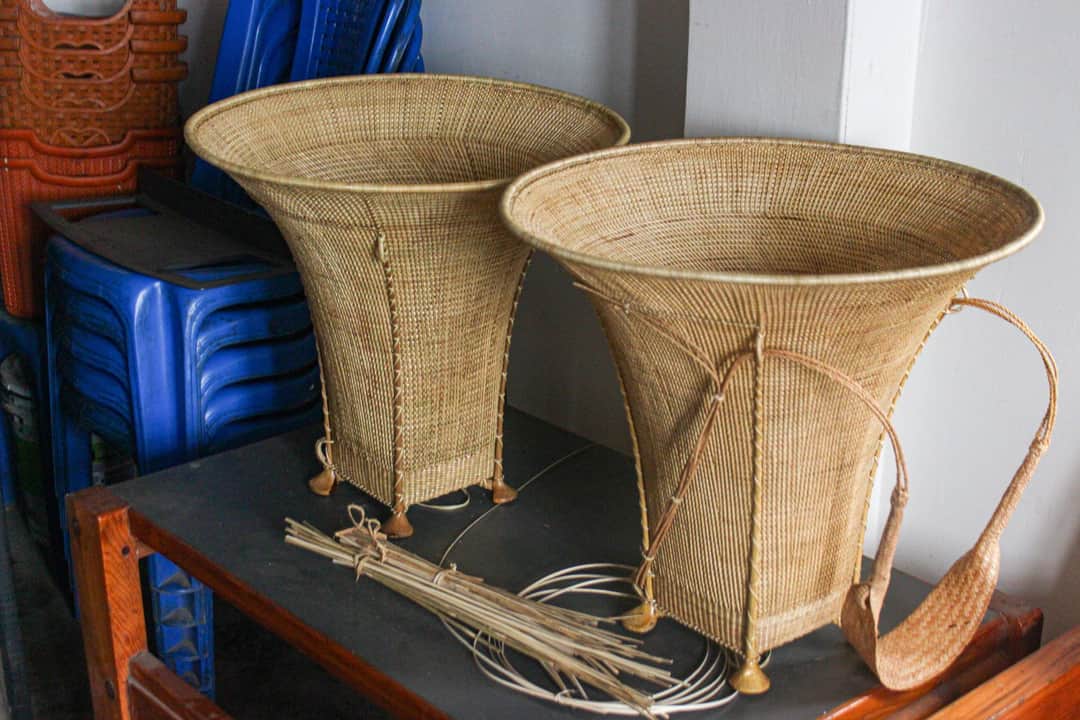


“Every Angami man should know how to weave a khophi,” says Pelesalie Kuotsu, 39, a weaver from Khonoma village in Nagaland. Made from züsa (bamboo) and thünye (cane), khophis are traditional Angami baskets used to hold firewood, grains of rice, harvested crops and ceremonial items. “It has played a big role in our traditions. It is something we must value forever,” he adds.
Once integral to the community’s lives and livelihoods, today, khophi weaving survives in fewer than 15 households in Khonoma, sustained mostly by older men; Pelesalie is an exception.
In his fifties, Kepekhoto Tho-u’s hands move with practised precision as he trims strands of bamboo, seated in a softly lit terhü, a partially covered structure made of bamboo beams, timber and cane, interwoven with dried leaves. The shade provided by the terhü cuts out the sharp edge of the midday sun.
“I come from a weaver’s home. My cousin brothers and I were all taught the craft of khophi basket weaving,” says Kepekhoto, working the bamboo strands as he speaks.
Angami are one of the 17 recognised tribes of Nagaland. Khonoma is a historic site of Naga resistance to British occupation in the 1800s. Angami village is located about 20 kilometres west of state capital Kohima and is known for its community-led conservation practices that include a ban on hunting and logging in the nearby forests, and organic farming methods.
Spread across 20 square kilometres of hilly terrain, the village is marked by stone-paved roads, terraced paddy fields and neatly stacked firewood outside traditional homes.
The village of just over 400 Angami households – a population of 1,943 (Census 2011), sustains itself largely through rice cultivation on stone terraces, shifting agriculture and forest produce. The surrounding forests are protected by the community, especially through the Khonoma Nature Conservation and Tragopan Sanctuary.