
Note: PARI has carried several stories on older people and also on disability. Now we will be focusing on them as specific themes. This is our first piece.
T

Sangrur, Punjab
|WED, OCT 01, 2025
In Punjab: Green Revolution, red harvest
Disabilities caused by farm machinery accidents are common in rural Punjab, but life moves on. On October 1, the United Nations International Day for Older Persons, a story about old age and disability
Author
Editor
Photo Editor
He lost his right arm decades ago, but Surjit Singh is still reluctant to accept that he has one limb less.
“I can do everything except reaping fodder – which needs two hands, one to hold it and the other to reap with the sickle,” says the old farmer. And then goes on to count a number of chores he carries out every day on his ten-acre farm in Rangian village of Sangrur district.
But Kulwant Kaur, his wife, enters the conversation, unhesitatingly tearing apart his claims. “He can’t tie the string of his trousers,” she says. “He can’t even properly clean himself after answering nature’s call in the morning. He doesn’t have a hand to reach out to soothe his back when an itch bothers him. He often rushes to rub his back against the wall or the tree trunk.”
Still, Surjit Singh did not ‘qualify’ for the benefits a disabled citizen is entitled to. He did approach the patwari (a village level government official who keeps land records). “But he told me ‘you are not eligible because you own land.’ So I came back home.” This was ridiculous as both landowners and landless are entitled to it under the law. Surjit neither got any compensation, nor does he get a disability pension (Rs.1,500 a month in Punjab). He does not even receive an old age pension – Rs.1,500 for those between 60-69 years, and Rs. 2,000 for those above 70.

Vishav Bharti
Surjit Singh lost his forearm to a chaff cutter and was denied both compensation and a disability pension. The local official told him, ‘you are not eligible because you own land’

Vishav Bharti
Kulwant Kaur, wife of Surjit Singh, says he was always passionate about work, and not having an arm has not stopped him from working on his farm in Rangian village of Sangrur district
At 72, he’s a quiet man who seems proud of nothing but his immense capacity to do endless labour with one hand. So how did he lose the other? That was in the mid-1990s, Surjit says. “My brother would often dissuade me from fodder chopping work as I would easily get distracted. That day we had just repaired the toka (chaff cutter) machines and were chopping sugarcane into a fodder. First my fingers got stuck into the rollers and it dragged my hand, then my arm,” he says as his reddish eyes go blank.
But his wife Kulwant Kaur, 65, picks up where he leaves off. “The arm was chopped into small pieces just like fodder and the blood was all around. I fainted when I saw that.” Surjit remained in hospital for around 20 days. But he had no time to pause and regret what had happened. There was, after all, a living to be earned. Around a month and half later he was back in the fields. “We came to know when one of our neighbours told us that even though he had tried to stop him, Surjit still climbed down into the borewell with one hand to fix it. I haven’t even seen him lamenting once for the lost arm,” says Kulwant.
“Had he both hands intact, he would have cast these walls in pure gold. He was always that hard working,” she says.
Surjit Singh and many like him mark another kind of ‘harvest’ of the Green Revolution and the technologies and automation it brought in the early 1970s. There are several stories like his in the villages of Punjab, but they stay buried in silence.
Vishav Bharti
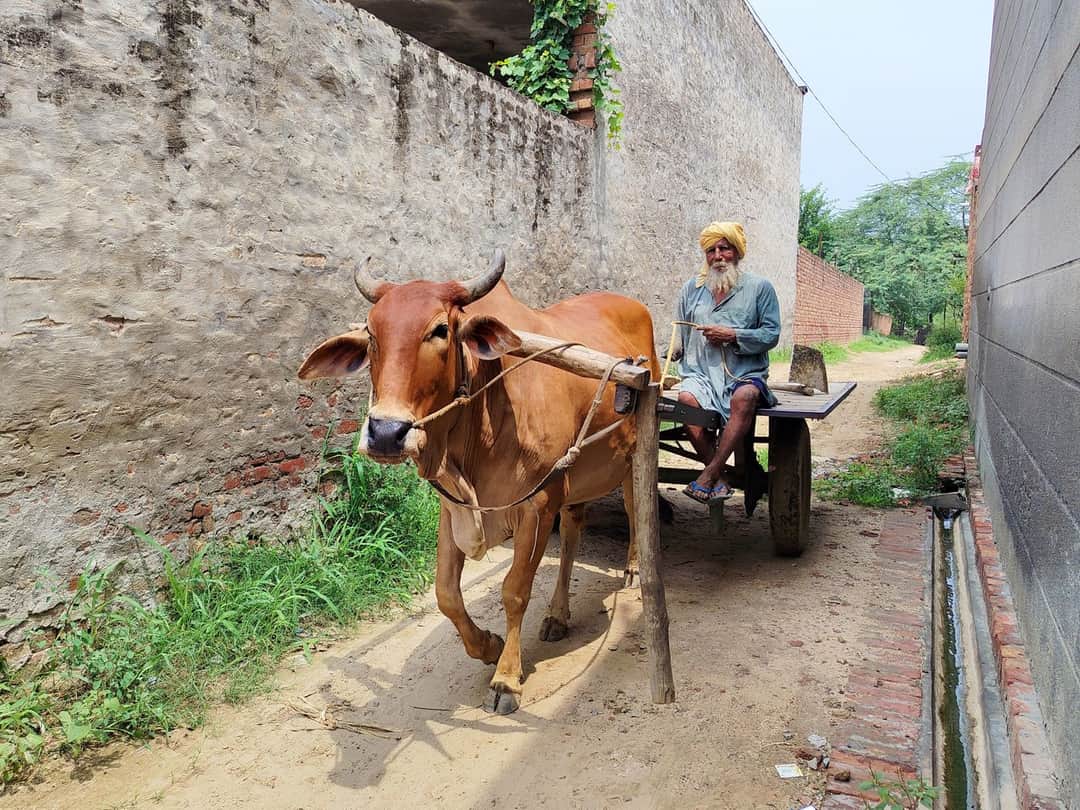
Surjit Singh on his bullock cart, returning home from the fields. With only one arm, he grips the cart’s beam with his legs to steady himself on the wobbly road and prevent falling
There were 841 farm machinery accidents between just 1975 and 1978 in this state alone.
Data compiled by the Punjab Agricultural Marketing Board found there were a total of 6,196 farm accidents between just 2007–12. Of these, 4,218, or 68.08 per cent, were with the chaff cutters. Another 1,395, or 22.51per cent, were with combine harvesters and threshers. And 583, or 9.41per cent, with tractors and related implements.
Another study analysing the marketing board’s accident data – which must be seen as conservative estimates – showed that chaff cutter and thresher-related mishaps resulted in amputation of fingers in 67.5 per cent of cases. A further 18.2 per cent led to amputation of hands. And 10.5 per cent saw the amputation of arms. That 2017 study on compensation to victims of agricultural accidents came from the Department of Farm Machinery & Power Engineering, Punjab Agricultural University, Ludhiana.
But the PAU study also queries the Marketing Board data and concludes that the actual number of farm accidents in just three years within the 2007-12 period was 9,188. And compensation of Rs. 250 million was spread across only 5,492 persons – on average less than Rs. 50,000 for each. Which means, presumably, that at least 3,696 accident victims or over 40 per cent of the total of 9,188, received no compensation.
These accidents started soon after the introduction of new kinds of machinery with the Green Revolution. There is hardly a village in Punjab where you won’t find someone with disability inflicted by farm accidents. Sadly, the post-disability scenario for the victims has too often remained grim. “The main economic problem is the large reduction in their annual income and the permanent physical disability,” notes a study done by the Chandigarh-based Institute of Development and Communication. “This makes them dependent upon others for daily routine work.”
Watch the video: In Punjab: unarmed but unshaken
Punjab was one of the first states to have a compensation policy for farm accident victims. The Indian parliament passed the Dangerous Machines (Regulation) Act in 1983. And Punjab, the following year, set up a financial assistance scheme for victims of farm accidents. But its implementation of that policy has remained very poor since its creation in 1984. Surjit is the living example of that.
In his own village of Rangian, which has a history of fighting against the feudal oppression of Patiala princely state, there were a number of cases of disability caused by accident due to farm machinery. Most of those sufferers have died since, but there are still two around, besides Surjit himself.
Pal Singh, a 73-year-old farmer, who lost his right hand and part of an arm to a thresher in 1982, still begins to tremble the moment that scene from four decades ago crosses his mind. “I was wearing a kada (Sikh bracelet). I can’t sit idle, so I started oiling the thresher – which was on and running. My kada got stuck in one of the oversized bolts in the feeder and it dragged my hand so forcefully that it broke off the bone. The next moment my hand was lying on the ground along with a part of the wrist. The thick round kada had turned rectangular. It was so painful you can’t even imagine. I wish my hand could have been chopped with a chaff cutter instead, which would have been much smoother,” he says.
Pal spent 20-25 days in hospital. However, just like Surjit, he too didn’t have time to dwell on the disaster. “I started driving a tractor within two months. Like always, tilling and sowing remained relatively easy, but I would even do levelling. I would start levelling work at 4 a.m. and would do it for 16 hours, which frequently required use of both hands.”
Life, he says, didn’t change a great deal for him. “Not much. Except that I always feel as if I have a tightly clasped fist and despite efforts, I can’t open it. Otherwise, I have trained my left hand in such a way that now I don't even remember that I had ever done something with my right hand.”

Vishav Bharti
Pal Singh lost his forearm to a thresher. He is among the few who gets a disability pension
Vishav Bharti
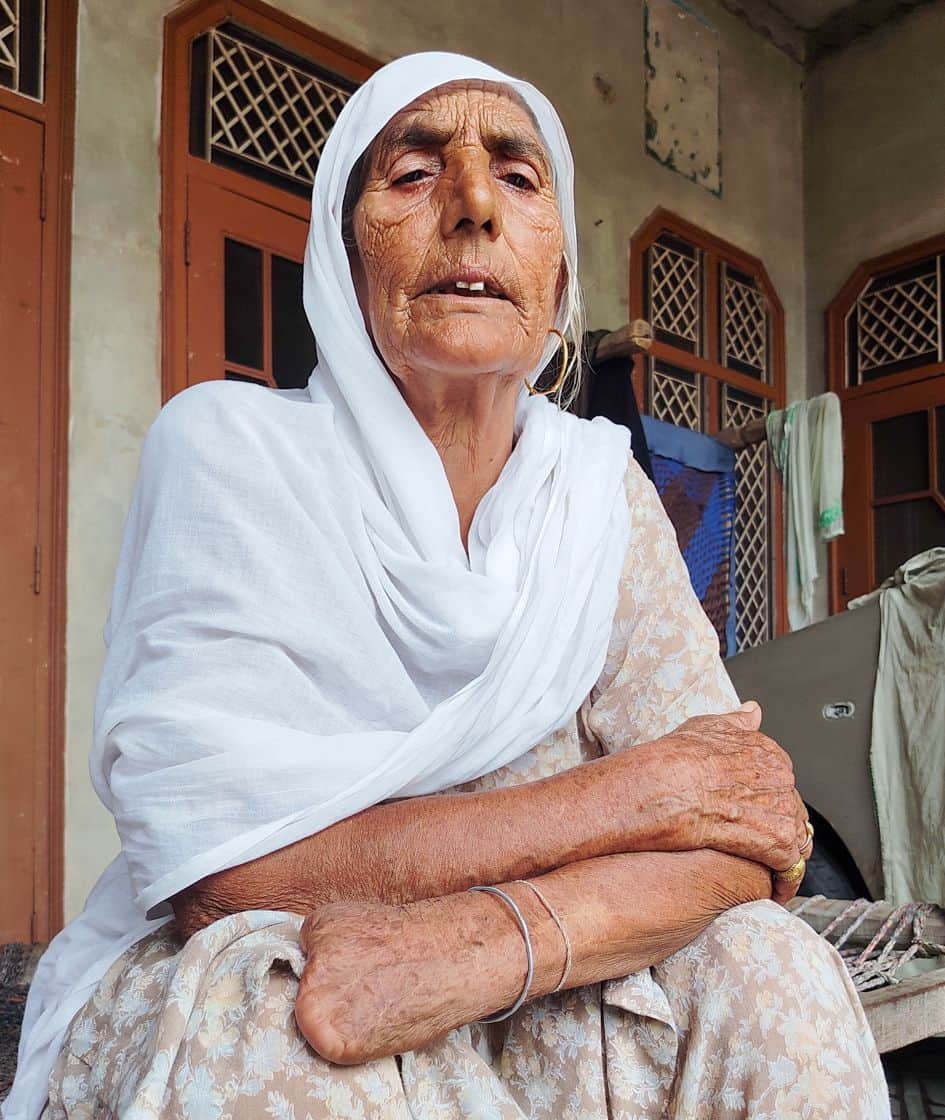
Naseeb Kaur from Ranigian village also lost her hand in a chaff cutter
Unlike Pal Singh, Naseeb Kaur, who is around 70 and from the same village, carries a burden of memories of her left hand. That got chopped off while working on a chaff cutter around a decade ago. “Chopping fodder was a routine, which I had been doing since my childhood. It was evening, around 7. First, my thumb got stuck in the rollers, then it swallowed my hand too. I started shouting but my daughter-in-law panicked and couldn’t stop the engine. The neighbours who heard my screams rushed to our house and stopped the engine and removed my hand from the machine.”
She is the only one of the three who receives an old age pension of Rs.1,500 a month. But got neither any compensation nor a disability pension. Only Pal Singh among these three gets a monthly disability pension of Rs.1,500. Surjit Singh gets nothing. Accessing benefits for a senior citizen has never been easy at the best of times. For those who are both senior and disabled, it’s a bureaucratic nightmare. Officials often simply dismiss their claims with wrongful or no explanations at all.
Naseeb recalls the days when she would comb her hair or make her braid, and she would handle kitchen work, or would milk the cattle swiftly – and suddenly plunges into thought. After a brief pause, she adds “Now I can’t.”
Vishav Bharti
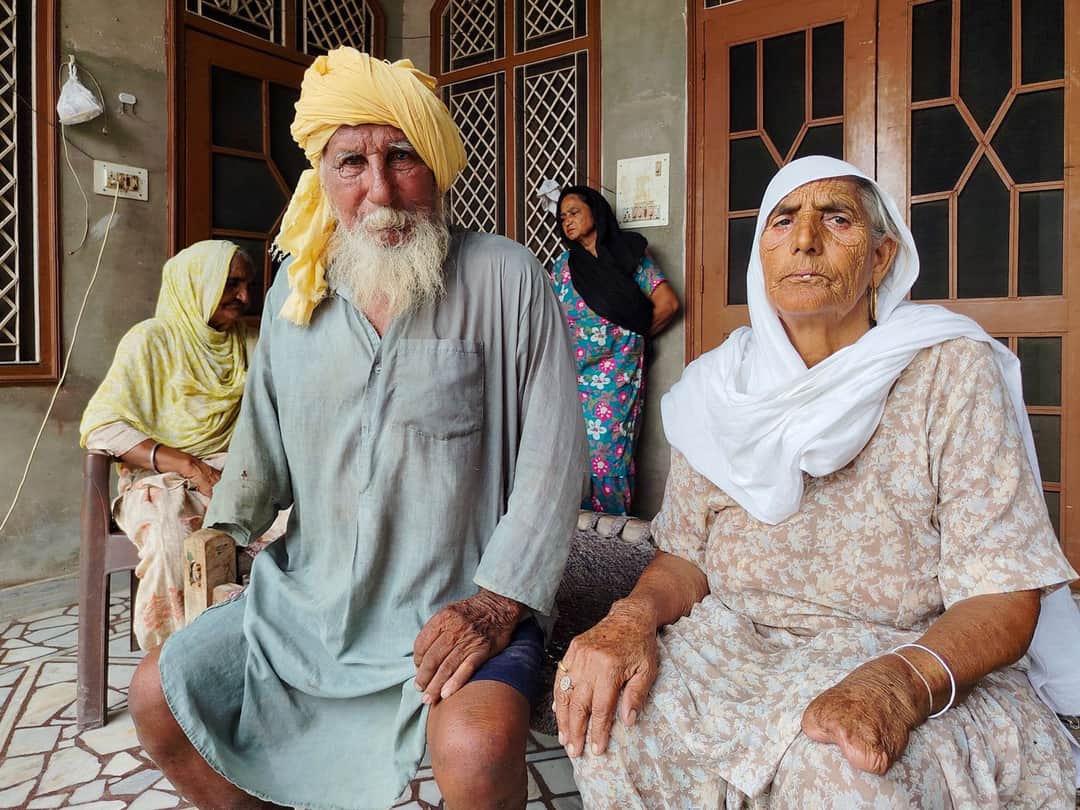
Punjab was one of the first states to have a compensation policy for farm accident victims, and a financial assistance scheme for victims of farm accidents. But its implementation has remained very poor since its creation in 1984
Can she roll rotis? “Yes, I have to. Though they come out in uneven shapes, what else can I do? What wrong did I do that I had to see all this?" Her eyes well up, tears roll down her cheeks, and she reaches for her white dupatta to wipe them. “The difficult time isn't forgotten easily,” Surjit’s wife Kulwant tries to console her.
Seeing all this, Surjit Singh quietly rises from the cot and heads towards the peg to which his ox is tied and starts opening the knots of the rope with the stump of the right hand. It seems his missing right arm still moves – unspoken, unseen, but never quite gone.
This story is published under the PARI Senior Fellowship 2025.
Want to republish this article? Please write to [email protected] with a cc to [email protected]
Donate to PARI
All donors will be entitled to tax exemptions under Section-80G of the Income Tax Act. Please double check your email address before submitting.
PARI - People's Archive of Rural India
ruralindiaonline.org
https://ruralindiaonline.org/articles/in-punjab-green-revolution-red-harvest