
15th May 2026. A disturbing news flash stopped me in the middle of my usual chores: 93 children rescued from a saree packaging unit in Surat, Gujarat. I wished Abbas had been one of them.
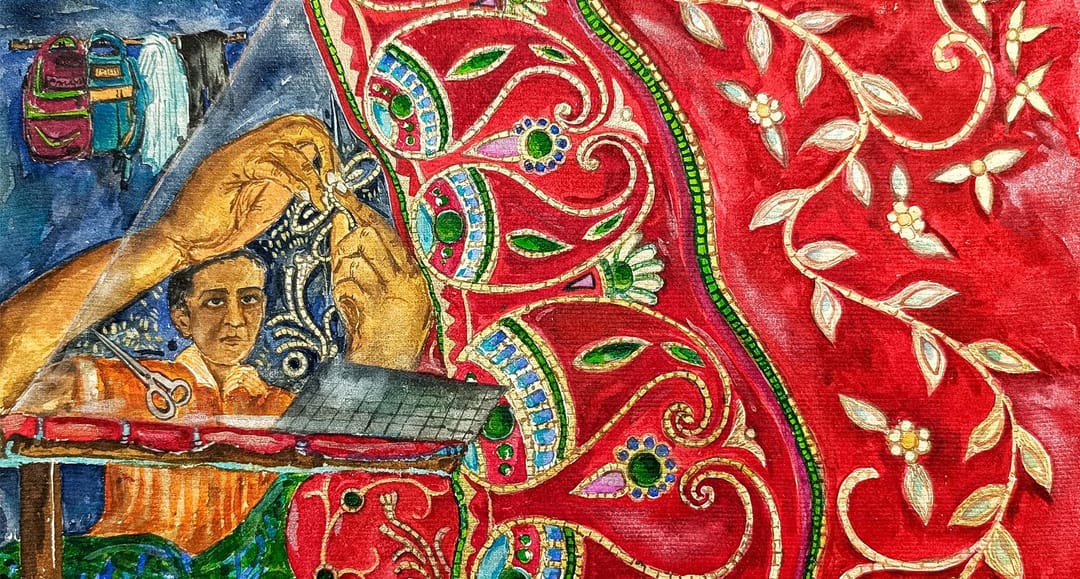
In a dimly lit, musty room thick with the scent of lint, I sat beside a frail child. He was huddled over his work, tracing intricate patterns of a field and flying birds, with metallic bullion threads in rich gold. He moves a fine aari needle with inconceivable dexterity to fill the patterns with sequins, beads and some precious stones on a saree stretched on the wooden frame. His fingernails were caked with yesterday’s dirt.
Abbas looked much like all the others trapped in that room then – large, hollow eyes and long, nimble fingers which the owners of the unit claimed were perfectly suited for precision work in this zari saree-making cell. Beyond a quiet nod and the methodical movement of his needles, Abbas had nothing to offer. He existed entirely outside of normal life, utterly unaware of the time, date, day or year.
“I don’t dream of going to school,” he said. “And I don’t go flying kites,” he whispered when I persisted gently with my questions. He was keeping his destitute family afloat. He told me that at night he sleeps either on the floor between the very frames he works on by day, or out on the concrete footpaths just outside the shutters. The grey ceiling of this dingy and poorly ventilated manufacturing cell was Abbas’ sky. I don’t think he had ever got to step out of from the unit.
But Abbas has travelled with me in my thoughts since then. When I saw the news, I wanted to turn the headlines into a song. To anchor the grief to a C Minor on the guitar. But the metaphor fell flat, refusing to carry the raw, suffocating weight I carried home the day I’d met him.