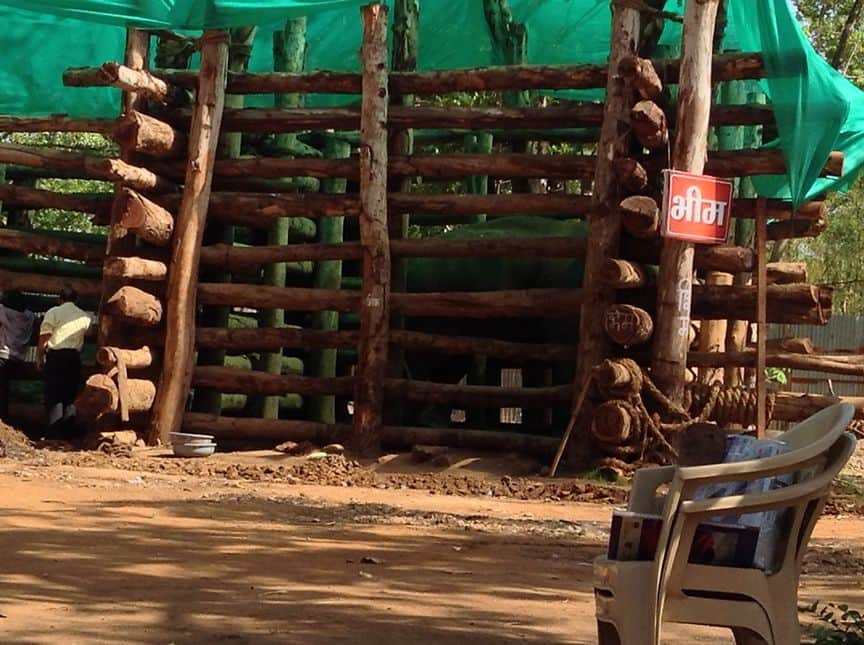
The cloud of intense fear may have dissolved from the air of Kudal, but the forest department has come under scrutiny for lacking foresight. One of the three captured wild elephants, during their training period, died in February this year. He was 40 while the average age of the elephant is 80. “It was a natural death”, says Kadam. “We did not treat him differently than the other two”. However, local journalist Chandu Shedge says, “There is no doctor in the area with expertise in elephant health. A doctor from Mysore visits the place upon being called”.
With the elephant categorized as an endangered species, its preservation becomes even more important. Moreover, one elephant requires 200 kilos of food comprising hay and foliage and an equal volume of water every day. Apart from that, sludge is dear to elephants. They often get embedded in it to decrease the body temperature in scorching heat as they do not have sweat glands. “With temperature pushing 40 degrees, it is practically not possible to arrange the required quantity of marsh in a kraal. We must ask ourselves if we have the capacity to tend to the elephants”, says Shinde. “In my opinion, we are lacking in manpower as well”.
Sunil Limaye, forest officer, Pune, regretted the demise of the elephant, saying “We will learn our lesson and in future ensure we live up to the standards and provide everything an elephant requires”.
But soon after, on a recent Saturday afternoon, Amberi lost its tranquility with one of the remaining two elephants shrieking throughout the afternoon.He already seemed under the weather and soon collapsed to the ground. His eyes turned red. 7-8 people started hysterically heaving him up to get him back on his feet. The sight was pathetic. The colossal pachyderm had turned so weak that he could not bear his own weight. Men tried to help him up with a rope but the tusker would get halfway up and crumble. After quite a few unsuccessful attempts, he lay motionless for a while like a frail warrior who had given up on everything.
The atmosphere grew frantic. Local vets were called and they applied saline. While others fed him banana trees, some arranged for a pipe and poured water on him. Later on, ice packs were applied. He did not get up the whole day as the other elephant watched helplessly. He was back on his feet the next day, but it was a temporary solace as he died within a month on 29 May.
“They must have a full-time elephant expert posted in Kudal”, says Shinde. Kadam concedes that Maharashtra is still figuring out a way to deal with wild elephants. “Karnataka has them for hundreds of years”, he says. “Before 2004, nobody in Maharashtra imagined a conflict like this”.
Another of the objections raised is the way in which the tuskers are trained. Eyewitnesses around the vicinity say the elephants are beaten up and tortured while training. “It is an orthodox method”, says Shinde. “A sensitive animal like elephant should be taken into confidence and then trained”. Experts believe the orthodox method may have led to the unfortunate deaths of the two elephants. “A wild elephant lives his whole life on his own terms. Suddenly he is trapped in an enclosure. It severely disturbs the psychology, thereby physical health”, says Shinde. “Elephants should be allowed to follow their natural instincts. If we provide appropriate habitat in a marked sanctuary, they would not stray into villages. Farmers would live sans fear and we would have also conserved forests”.
Limaye says a “Dandeli-Tillari Elephant Reserve” along the Maharashtra and Karnataka border could be a long-term solution to the conflict. “It could be a joint initiative of the Maharashtra and Karnataka governments”, he says, adding that an immediate goal is “to educate farmers and create awareness” as panicky behavior induces aggression among wild elephants, causing deaths. Limaye also believes that the “compensation process should be swifter”.
Dr N.V.K Ashraf, the chief of conservation at the Wildlife Trust of India, has an out-of-the box suggestion for farmers. “Cultivate crops that attract pachyderms at the core of the land”, he says. “Elephants hate lemons, chilies, beehives. Nurture them on the borders of the farm”.
Suggestions abound but with shrinking spaces for the wild animals and human encroachments on the rise, the solutions are few, with both groups living in fear and losing out on freedom and a lot more.
Meanwhile, as the sun makes its lazy journey down the sky, Nhano’s wife ensures all the windows and doors are firmly locked. She orders her grandnephews, sons and daughter-in-laws back in the house as Nhano gets ready with a stick and torch to spend the night on the perch at the farmland. It is his turn today.